Back to aLinDev's profile
aLinDev

Posts by aLinDev

4,385 posts

  1. #3041
    Reply in IT news

    mazon's Echo Spot brings you all the features of its Echo, with a screen for displaying weather forecasts, news updates, sports scores, song lyrics and much more. All you need to do is ask Alexa. It fits comfortably on a nightstand and works well as an alarm clock and bedside calendar as well. Watch videos, call your friends, control your smarthome -- new features are added all the time. Right now, if you buy two, Amazon will activate a $40 discount in your cart. See this deal now on Amazon.

    This story, "Amazon Is Offering a $40-Off Deal On Its Echo Spot Devices" was originally published by PCWorld.

  2. #3042
    Reply in IT news

    NordVPN


    NordVPN promises a private and fast path through the public internet, with no logs and unmetered access for 6 simultaneous devices. They are currently running a promotion, but you'll have to use this link to find it. Its typical price has been discounted to $99 for 3 years of service. That's a good deal at just $2.75 per month.  See the $2.75/month NordVPN holiday deal here.

    This story, "Get 3 Years of NordVPN Service for Just $2.75 Per Month" was originally published by TechConnect.


  3. #3043
    Reply in IT news

    Apple has surpassed Samsung as the world's leading shipper of smartphones, according to two industry reports released today.

    Though IDC and IHS Markit had differing numbers for the fourth quarter of 2017, the result was the same: Apple handsets surpassed Samsung in shipments for only the second time in history.

    "The new models from Apple played a key role in moving Apple ahead of Samsung in Q4," said Ryan Reith, vice president for IDC's Mobile Device Tracker report.

    According to Apple's own numbers, it's selling about 10 iPhone per second -- most of which are iPhone X's.

     
    Apple yesterday announced quarterly revenue of $88.3 billion, an increase of 13% year-over-year -- an all-time record. International sales accounted for 65 percent of the quarter’s revenue.

    [ Related: 8 ways businesses can take advantage of the iPhone X ]
    Apple once before surpassed Samsung in handset shipments – in the fourth quarter of 2016. But that was considered an anomaly by analysts at the time.

    "Apple had a good holiday quarter [in 2016], but it was also the same time Samsung was going through that whole issue with the Note 7 and the battery issue. So Samsung was having its own issues, while Apple was doing well," Reith said. "There was no anomaly this quarter. There's no question [Apple is] gaining traction."

    Apple shipments, Reith said, are driven by holiday sales because their new product release cycle comes just prior to that season.

  4. #3044
    Reply in IT news

    Browsers built by Microsoft and Mozilla jettisoned some of their precious user share in January, while Google's broke out of a months-long malaise by grabbing what its rivals lost, and then some.

    According to California-based analytics vendor Net Applications, the user share of Internet Explorer (IE) and Edge - the estimated portion of all personal computer owners who ran those browsers - fell by half a percentage point to 16.5% in January.

    [ Further reading: What's in the latest Chrome update? ]
    After a one-month reprieve from losses - IE+Edge had climbed in December - Microsoft's browsers returned to their long-time pattern of decline. The 16.5% mark was the second-lowest for Microsoft's combined user share in the decade that Computerworld has recorded Net Applications' numbers.

    Together, the two browsers ran on about 19% of all Windows PCs, or on slightly less than one in five systems. That was the lowest-ever share of Windows PCs for the pair and stood in stark contrast to the 52% they accounted for just two years ago.

     
    January 2016 was a red-letter month for IE because it was then that Microsoft stopped serving security updates to most editions of its kingpin browser, forcing customers to upgrade in most instances to IE11. Many instead switched browsers. It was Microsoft's decision to retire non-IE11 editions that fueled the rise of Google's Chrome.

    And Edge, the default browser for Windows 10, has not taken up IE's slack by any measure. Edge's own user share - less than 5% - meant that the browser ran on fewer than 14% of all Windows 10 machines in January, or less than one in every seven devices powered by the OS.

    If IE's collapse has been Microsoft's biggest browser defeat, then the inability of Edge to capture more than a piddling part of the Windows 10 audience has been the company's second-largest failure. Simply put, Windows 10 users have rejected Edge.

    Meanwhile, Mozilla's Firefox shed two-tenths of a percentage point, ending the month at 10.85%, that browser's lowest share since September 2016. The November overhaul, on which Mozilla has pinned great hope, has yet to boost the browser's user share, even though reviews of what the company calls "Firefox Quantum" have generally been upbeat.

    Because browser user share is a classic zero-sum exercise - if one browser loses part of the available 100%, one or more others must gain - it was no surprise that Chrome picked up eight-tenths of a percentage point in January, the largest increase since the same month of 2017. Chrome accounted for 61.4% of last month's user share, according to Net Applications.

    Chrome has been the biggest recipient, by far, of the dual decline of Microsoft's IE and Mozilla's Firefox. Google's browser is within striking distance of accounting for two-thirds of the world's user share, a mark it could reach by November based on trends over the last quarter.

    The same trend line now forecasts that IE+Edge, as well as Firefox, will head in the other direction. Computerworld calculated that IE+Edge could slip below the 10% bar as soon as August, while Firefox will beat it there, with a shot at dropping under 10% in March.

    Net Applications calculates user share by detecting the browser agent strings of those who visit its clients' websites. It then tallies the various browsers, accounting for the size of each country's online population to better estimate share in regions where it lacks large numbers of analytics customers.

    Other data sources painted a picture that resembles Net Applications'.

    [ To comment on this story, visit Computerworld's Facebook page. ]
    Irish metrics company StatCounter pegged IE+Edge's January decline at a half percentage point to 11.4%, and a Firefox slide of four-tenths of a point, to 11.9%. Chrome, on the other hand, added 1.3 percentage points to its usage share - a different measurement than Net Applications' user share, and akin to activity - ending January with a remarkable 66%.

  5. #3045
    Reply in IT news

    A newly created branch of Google’s V8 JavaScript engine promises to improve compilation of the WebAssembly portable code format via streaming compilation in V8’s WebAssembly API. V8’s Version 6.5 branch is now in beta but expected in the Chrome 65 Stable browser release in a few weeks.

    V8 is a staple in both the Chrome browser and the Node.js JavaScript runtime. WebAsembly is also supported in Mozilla Firefox, Apple Safari, and Microsoft Edge, though those browsers do not use V8.

    [ Go deeper at InfoWorld: Beyond jQuery: An expert guide to JavaScript frameworks • The complete guide to Node.js frameworks • The 10 essential JavaScript developer tools • The 6 best JavaScript IDEs and 10 best JavaScript editors. | Keep up with hot topics in programming with InfoWorld’s App Dev Report newsletter. ]
    New features in V8 Version 6.5

    In V8 Version 6.5’s streaming compliation, WebAssembly modules are compiled while module bytes are still being downloaded. When all bytes of a single function have been downloaded, the function is passed to a background thread for compilation. As a result, WebAssembly compilation in Chrome 65 can maintain a 50Mbps download speed on high-end machines, Google says—meaning that if WebAssembly is downloaded at that speed, compilation finishes as soon as the download is done.

     Other improvements planned for the 6.5 branch include:


    • An untrusted code mode, developed in response to a specualative side-channel Spectre attack. This mode is suitable for applications processing user-generated, untrusted code and is enabled by default.

    • A mechanism to detect and prevent a deoptimization loop. This loop occurs when optimized code deoptimizes and there is no way to find out what went wrong. V8 developers also have inlined many JavaScript builtins that had been excluded because of a side effect between the load of a function to call and the call itself.

    Where to download the V8 Version 6.5 branch

    You can download the V8 Version 6.5 branch from Google’s Git repo.

    This story, "What’s new in Google's V8 JavaScript engine" was originally published by InfoWorld.

  6. #3046
    Reply in IT news

    If Broadcom gets its way, there could be one booth fewer at next year's Mobile World Congress trade show in Barcelona.

    The semiconductor manufacturer upped its takeover bid for smartphone microprocessor maker Qualcomm on Monday, saying this is its final offer.

    Chips from one or other of the two are inside most smartphones -- and many other devices found in corporate IT infrastructure where they power storage and wired and wireless networking.

    Our new gaming site is live! Gamestar covers games, gaming gadgets and gear. Subscribe to our newsletter and we’ll email our best stuff right to your inbox. Learn more here.
    A merger of the two could result in greater synergies in design and development -- or it could allow a single, powerful supplier to jack up prices in some markets.

     
    Last November Broadcom offered to acquire Qualcomm for US$70 per share, or around $103 billion, but Qualcomm's board rejected the bid, saying it wanted tens of billions more.

    It's almost got it: Broadcom has increased its offer to $82 per share, or over $120 billion.

    Qualcomm is in the middle of a giant acquisition of its own, seeking to buy chip maker NXP Semiconductors. Broadcom made its latest offer conditional on Qualcomm closing that deal at the current offer price, or walking away from the deal: It's OK with raising its own bid, but doesn't want its target spending any more money.

    The offer for Qualcomm dwarf sBroadcom's last big acquisition, in which it paid $5.5 billion to acquire Brocade, a manufacturer of networking hardware for data centers.

  7. #3047
    Reply in IT news

    Anti-drugs campaigns were such a success, a group of Silicon Valley insiders are hoping to use a similar strategy to turn teens off technology -- or at least teach them to use it responsibly.

    The Center for Humane Technology warns that mobile apps like Snapchat, Instagram, Facebook and YouTube are designed to addict us, and are eroding the pillars of our society.

    And now, along with Common Sense, a nonprofit that serves children and families, it's launching a campaign to "protect young minds from the potential of digital manipulation and addiction."

    Our new gaming site is live! Gamestar covers games, gaming gadgets and gear. Subscribe to our newsletter and we’ll email our best stuff right to your inbox. Learn more here.
    Among the damage that attention-seeking apps can cause, the groups list cognitive disorders, depression, loneliness, stress, anxiety, suicidal thoughts, loss of productivity and a lack of critical-thinking skills.

     
    The two groups hope that by providing children and families with more information about how online media work, they will be able to pressure the companies behind them to make them less intrusive and less addictive.

    The Center for Humane Technology was co-founded by Tristan Harris, its executive director and a former design ethicist at Google.

    He's calling on app developers to turn things around: "Plenty of smart engineers and designers in the industry want to create apps that provide us with the information we need to improve our lives as quickly as possible, instead of just sucking us in for as long as possible," he said Monday.

    How long is possible? In 2015, a survey for Common Sense found teenagers consumed an average of nine hours of digital media per day.

     
    For users wanting to reduce social media consumption without going completely cold turkey, the Center offers some simple steps. Number one is to turn off mobile app notifications that aren't from real people -- so, for example, you might turn off alerts from Facebook, which are likely just exhortations to visit the website and keep you "engaged," but keep alerts from Facebook Messenger or WhatsApp.

    Making it less stimulating to look at your mobile phone by turning its display to grayscale using the accessibility settings is another easy one. Making it more difficult to open social media apps in moments of boredom takes more effort. You can do this by moving the relevant icons to the second page of apps on your phone, not the home screen, or by hiding them altogether so that you can only open certain apps on your phone by searching for them by name.

    Lastly, the group advises, don't keep your smartphone charger in your bedroom: Leave it to recharge its batteries somewhere else while you recharge yours.

  8. #3048
    Reply in IT news

    Choosing the right virtual private network (VPN) service is no simple task. A VPN should keep your internet usage private and secure, but not every service handles your data in the same way. Just look at the critiques of notable computer security experts and online pundits to understand the challenge.

    (Want to know more about VPNs and what they can and can’t do? Skip down to our “What is a VPN?” section below.)

    VPN cheat sheet

    Our quick-hit recommendations:

    Since it takes research to find out if a VPN service has a history of good or bad behavior, we’ve done the legwork to find the best VPN out there. In order to win our seal of approval, the service has to protect online privacy; allow you to keep anonymity; offer a good variety of locations from which to direct your traffic; offer fast, reliable performance; and provide an easy-to-use interface.

    If you’d like to have more flexibility and choose for yourself, we also offer our tips on what to look for in a VPN. Just keep reading past our Best VPN and Best VPN for U.S. Netflix recommendations. (And if you live in the United Kingdom and are looking for a VPN, check out VPN recommendations from our sister site, TechAdvisor.)

     
    Links to full reviews of all the VPN services we tested can be found at the very bottom of the page. 

    Updated 2/6/18 to add a brand-new category to our list: Best VPN for torrents. Many of the top VPNs are up to this task, but see why we’ve deemed Private Internet Access exceptionally proficient.


    TABLE OF CONTENTS

    SHOW MORE 

    Best VPN overall

     

    Mullvad


    Read PCWorld's review

    MSRP $67.00

    LEARN MORE

    on Mullvad

    Sweden-based Mullvad is like the Swiss Bank account of VPNs. Instead of attaching your account to an email address, the company auto-generates an account number for you, and that's all that's required to log in. Mullvad offers a bare-bones interface, but its speeds are good, and the company takes privacy very seriously.

    In truth, it’s hard to select the best overall VPN. Some services are weaker on privacy, but are significantly easier to use, while others could stand an interface redesign.

    Nevertheless, the point of a VPN is to remain private and to have your internet activity kept as private as possible. For that reason, we’re choosing Mullvad as the best overall VPN (see our full review of Mullvad). The interface needs a lot of work, but the company does a great job at privacy. Mullvad doesn’t ask for your email address, and you can mail your payment in cash if you want to. Like many other VPNs, Mullvad has a no-logging policy and doesn’t even collect any identifying metadata from your usage.

     
    Mullvad is also fast, even if it’s not the fastest VPN we’ve tested. Add a more user-friendly interface and Mullvad would be nearly unbeatable.

    Runner-up

     

    CyberGhost


    Read PCWorld's review

    $59.88

    VIEW

    on CyberGhost

    CyberGhost is an easy-to-use VPN with impressive speeds with features that will appeal to both novice and experienced users.

    CyberGhost gives Mullvad some stiff competition in the speed department, especially for locations in North America and Europe. It does a good job protecting user anonymity, too—requiring no identifying information and using a third-party service for payment processing—albeit not to the same degree as Mullvad. Add to that CyberGhost’s unique, easy-to-use interface, good price, and streaming unblocking (although not for Netflix), and this VPN is a solid choice. (See our full review of CyberGhost.)

    Best VPN for U.S. Netflix

    MENTIONED IN THIS ARTICLE

    Windscribe Pro


    Read PCWorld's review

    $49.00MSRP $49.00

    VIEW

    on Windscribe

    Windscribe won't win any speed showdowns compared to other VPNs we've looked at, but it's still got some great servers in Europe and North America. The service also has added extras like a link shortener with warnings about ad trackers on the destination page, and it currently works with U.S. Netflix.

    If you live outside the U.S. (or are a U.S. resident and traveling abroad), a VPN is the only way to access Netflix’s US library. But ever since Netflix began blocking VPNs, few services even bother to do battle with the streaming behemoth.

    Fortunately, there are some brave companies that are still trying to stay one step ahead of Netflix’s VPN catchers. Currently, Windscribe Pro is our top choice. The service delivers good speeds on its U.S. servers, and has a very simple approach to Netflix: Just select the “Windflix” connection from the desktop app or browser extension and you’re good to go. Windflix is still technically in beta, but it works well and there’s even a Windflix U.K. option if you’d like to experience Netflix from the other side of the pond.

    Of course, Netflix could block access at any time, but right now Windscribe is one step ahead of the streaming giant’s crackdown. (For more about Windscribe Pro see our full review.)

    Fastest VPN

    MENTIONED IN THIS ARTICLE

    HotSpot Shield Elite


    Read PCWorld's review

    $71.88MSRP $71.88

    VIEW

    on AnchorFree

    HotSpot Shield offers fast speeds, a beautiful and simple desktop app for windows, and 25 country locations. But it's privacy policy means your activities are recorded—though not tied to you. Still, this is not what privacy-conscious users will be looking for.

    HotSpot Shield has some of the best speeds we’ve seen yet, and it’s not even close. In our tests, HotSpot Shield dipped around 35 percent below the base speed. That’s substantially less impact than you’ll see with most VPN services—though your

    experience may vary.

    On the downside, HotSpot Shield doesn’t allow for a way to pay anonymously and its privacy policy may not sit well with some.

    Still, HotSpot Shield has excellent speeds, it’s desktop application is very nice, and as a bonus it works with U.S. Netflix (read our full review).

     
    Best VPN for U.S. speeds

     

    IVPN


    Read PCWorld's review

    $100.00MSRP $100.00

    VIEW

    on IVPN

    Gibraltar-based IVPN has a small network of servers, but good speeds, and a solid privacy policy. It's pricier than most VPN servers, but for those who don't need a wide number of country choices it can be a good choice.

    IVPN has by far the best speeds we’ve seen on U.S. (and UK) connections. Your individual results may vary, but with a free, three-day trial, anyone looking for good speeds from the U.S. or UK should give IVPN a try. IVPN’s Windows program is very easy to understand and manage; however, it is a pricey service at $100 per year

    and there’s no guarantee it will work with Netflix. (Read our full review.)

    Best VPN for torrents

    MENTIONED IN THIS ARTICLE

    Private Internet Access


    Read PCWorld's review

    MSRP $40.00

    LEARN MORE

    on Private Internet Access

    Private Internet Access has an excellent price and recently backed up its privacy-policy claims in dealings with the FBI. It also has good number of country locations and a ton of servers.

    Torrents get a bad rap, and if we’re honest, that’s for good reason. Using torrents is the number one way to download pirated material including movies, TV shows, music, and games. But that’s not all there is to torrenting. It’s a very efficient way to download legitimate software such as Linux distributions and authorized content from sites such as BitTorrent Now.

    If you’re going to use torrents, however, life is easier if you use a VPN—especially if the network you’re on blocks torrenting. There are many VPNs among our top picks that could be used for downloading torrents, but our preferred choice is Private Internet Access. This no-frills VPN has an absolute ton of servers, good speeds, and a nice amount of country locations to remain relatively anonymous. (Read our full review.) The price is right at less than $40 a year, and its privacy policies have been tested in court. Plus, advanced users can adjust their level of encryption for data encryption, data authentication, and handshake.

    What is a VPN?

    VPNs create a secure tunnel between your PC and the internet. You connect to a VPN server, which can be located in the United States or a foreign country—say, France or Japan. Your web traffic then goes through thatserver to make it appear as though you’re browsing from that server’s location, and not from your actual location.

    When you’re using a VPN, it’s difficult for others to snoop on your web-browsing activity. Only you, the VPN service, and the website you’re visiting will know what you’re up to. 

    A VPN can be a great response to a variety of concerns, such as online privacy, anonymity, greater security on public Wi-Fi, and, of course, spoofing locations.
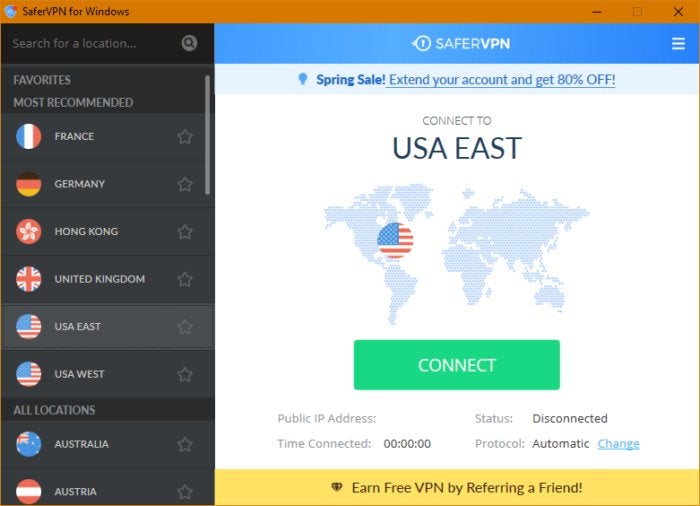


    SaferVPN
    A good VPN offers you a wide variety of locations to connect to. 

    While a VPN can aid privacy and anonymity, I wouldn’t recommend fomenting the next great political revolution by relying solely on a VPN. Some security experts argue that a commercial VPN is better than a free proxy such as the TOR network for political activity, but a VPN is only part of the solution. To become an internet phantom (or as close as you can realistically get to one), it takes a lot more than a $7 monthly subscription to a VPN.

    If you want a VPN for political reasons, this article cannot help. But there are other places you can turn to online such as the Electronic Frontier Foundation.

    Moving on to less serious topics, a VPN is an excellent choice for staying secure while using Wi-Fi at the airport or your local café. Hackers sitting on public Wi-Fi can try to hack your PC, but a VPN makes that task much harder.

    Finally, you may want a VPN to spoof your location to download content you shouldn’t have access to, but this too has limits. A VPN used to be the go-to solution to watch U.S. Netflix overseas. That changed in 2016 when Netflix opened up to almost every country on Earth. Since then, the company has invested a lot in detecting and blocking VPN users. Even people using a VPN inside their own country will be blocked by Netflix if detected.

    There are VPNs that can fool Netflix, but they are rare and there are no guarantees these services will outsmart Netflix forever.

    Beyond Netflix, a VPN can help to download an Android app that is only available on a foreign version of Google Play, or stream content from regionally restricted services such as the UK-bound BBC iPlayer or Pandora.

    One final note of caution: Do not rely on your VPN to protect banking information on an open Wi-Fi connection. Whenever possible, leave online financial dealings for home over a hard-wired connection.

    What to look for in a VPN

    Before anything else, understand that if you want to use a VPN you should be paying for it. Free VPNs are either selling your browsing data in aggregated form to researchers and marketers, or giving you a paltry amount of data transfer every month. Either way, a basic rule of thumb is that a free VPN will not protect your privacy in any meaningful way.

    The next thing to consider is a VPN’s logging policies. In other words, what kind of data is a service collecting about you and your VPN activity, and how long is that data saved?

    Privacy is the basic principle of a VPN, and what good is it to avoid passive government surveillance only to have a VPN provider record all your website visits?

    Ideally, a VPN will say it only keeps logs for the briefest of periods. Some providers, for example, only log activity in RAM during a session or automatically send all records to oblivion once they’re created. Other providers may keep records for a few hours, days, weeks, or even months.
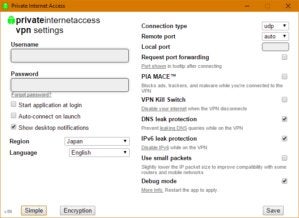


    Private Internet Access
    The settings window for Private Internet Access.

    VPN policies also vary when it comes to personal information. Some VPNs want to know very little about you, preferring users sign on with a pseudonym and pay with Bitcoin. That’s a little exotic for most people, which is why many services also accept PayPal.

    Paying this way isn’t ideal for privacy, but it means the VPN doesn’t have your payment information on record—though it would be available from PayPal.

    After the logging policies, you want to know how many servers the VPN offers and how many country connections it has. The number of servers provides an idea of how much load a VPN can take before slowing to a crawl due to overwhelming traffic.

    The country connections, meanwhile, matter most to those who want to spoof their location; however, non-spoofers should also make sure there are connections in their home country. If you live in Los Angeles, for example, and want access to American content, then you’ll need a VPN that provides U.S. connections. It won’t work to try and watch Amazon Prime Video over a Dutch VPN connection, because as far as Hulu’s concerned your computer is in the Netherlands.

    Some users will also want to research a VPN provider’s peer-to-peer (P2P) file-sharing policies. There are VPNs that block torrents. Others turn a blind eye to them, but will sell you out in a heartbeat should you be up to no good. P2P is not our main focus here, but we will note in each review whether a particular provider allows file sharing or not.

    Finally, how many devices does a VPN support from a single account? In this age of smartphones, tablets, laptops, and PCs, a VPN’s cost should include licensing for at least five devices. Also, a provider should have Android and iOS apps to make it easy to connect a smartphone or tablet to the service.

  9. #3049
  10. #3050
    Reply in IT news

    When you create an app for only iOS or Android, you alienate a significant portion of your potential market. That's why Xamarin has emerged as a popular app-building tool thanks to its cross-platform capabilities. Now 90 percent off, the Xamarin Cross Platform Development Bundle can show you how to build apps compatible with both platforms across 57 hours of training.

    As you make your way through six programming courses, you'll discover how to build applications for Android and iOS simultaneously using the C# programming language in conjunction with Xamarin. Once you're comfortable working with these tools, you'll create your own app projects, like a magnet detector and music player.

    The Xamarin Cross Platform Development Bundle usually retails for $1,046, but you can get it on sale for over 90 percent off, bringing the final price down to $35.

  11. #3051
    Reply in IT news

    Microsoft’s .Net Core, a cross-platform implementation of the company’s .Net development platform, is being readied for its 2.1 release, featuring improvements to build time performance and tools deployment.

    When to expect .Net Core 2.1

    The open source .Net Core 2.1 is due in beta form this month, with a production release expected by summer 2018.

    [ Microsoft .Net Core 2.0: Everything you need to know. | Why .Net Core is finally ready for prime time. | .Net Framework or .Net Core? Learn when to use which. | Keep up with hot topics in programming with InfoWorld’s App Dev Report newsletter. ]
    Improved features in. .Net Core 2.1

    Application-building performance will be much better than it was with the 2.0 and 1.0 versions of .Net Core, Microsoft promises. This is particularly true for incremental builds.

    Improvements apply to dotnetbuild on the command line and Visual Studio builds. As part of its build enhancements, Microsoft has improved CLI and MSBuild tools for faster performance.

     
    Other improvements envisioned for .Net Core 2.1 include:

    • A new deployment and extensibility mechanism for tools, referred to as .Net Core global tools. It replaces .Net CLI Tools. The experience will be similar to Node global tools, reusing the same syntax. Microsoft anticipates a new ecosystem arising for .Net tools.

    • A smaller runtime install.

    • The availability of the SignalR library for real-time web functionality, in ASP.Net Core 2.1. A companion to .Net Core, ASP.Net Core is a framework for building internet-connected applications. HTTPS is also on by default in ASP.Net Core 2.1.

    • To handle outgoing network requests, a rewritten HttpClient handler promising two to ten times the performance.

    • A set of types, including the Span <T> type (pronounced “span of tee”), providing a uniform representation of memory from multiple sources, including stack allocation and native code. These types are expected initially to help with performance-critical situations and then become a replacement for arrays as a mechanism for handling large blocks of data. One type, Tensor <T>, is specific to machine learning.

    • For compatibility with .Net Framework, the Windows Compatibility Pack. It offers access to an additional 20,000 APIs compared to what has been available in .Net Core. Released in a beta version in November, the pack offers APIs such as System.Drawing, EventLog, and Windows Services.

    • The API Analyzer tool, to ensure developers do not only depend on Windows APIs.

    • Support for applications on later runtime versions in the same major version range. For example, a .Net Core 2.0 application could run on .Net Core 2.1.

    • Crypto improvements, including support for signing NuGet packages.

  12. #3052
  13. #3053
  14. #3054
    Reply in IT news

    Microsoft’s group chat tool, Teams, may have garnered more attention when it launched last year, leaving Planner – aimed at helping teams coordinate projects, share files and work more effectively – largely in the shadows.

    Billed as a lightweight, collaborative and highly visual task management tool, Planner is positioned as a rival to the popular Trello (just as Microsoft’s Teams is seen as its answer to Slack). But in a crowded collaboration field, Planner also matches up against tools like as Asana and Smartsheet, which offer alternatives to more complex project management applications.

  15. #3055
    Reply in IT news

    Microsoft’s group chat tool, Teams, may have garnered more attention when it launched last year, leaving Planner – aimed at helping teams coordinate projects, share files and work more effectively – largely in the shadows.

    Billed as a lightweight, collaborative and highly visual task management tool, Planner is positioned as a rival to the popular Trello (just as Microsoft’s Teams is seen as its answer to Slack). But in a crowded collaboration field, Planner also matches up against tools like as Asana and Smartsheet, which offer alternatives to more complex project management applications.

  16. #3056
    Reply in IT news

    Microsoft's shift to Windows-as-a-service (WaaS) for Windows 10 crafted a repetitive, predictable schedule of version release and support expiration dates for Windows 10.


    Although consumers can essentially ignore any schedule - Microsoft decides when their devices are upgraded - business customers and their IT personnel should be marking the calendar with the important upcoming events.

  17. #3057
    Reply in IT news

    An average of 5,000 to 7,000 new computer security threats are announced each year. That’s as many as 19 every day. The rate at which new threats appear make it difficult to decide which ones require your attention. It might surprise you that, while your competitors waste money on high-tech, expensive, and sometimes exotic defenses, you can get far more value by concentrating on just two things you already do.  You can spend less money and nothing you do otherwise will provide a better defense.

  18. #3058
    Reply in IT news

    Cortana is a voice-enabled virtual assistant developed by Microsoft to help Windows 10 users initiate requests, complete tasks and anticipate future needs by surfacing relevant data in a personal context. Since Cortana’s release on Windows 10 in January 2015, the technology has evolved to support Android and iOS devices, Xbox, the Edge browser, Windows Mixed Reality headsets and third-party devices such as thermostats and smart speakers. According to Microsoft, Cortana is currently used by more than 148 million people.

  19. #3059
    Reply in IT news

    Microsoft is ramping up efforts to win over customers from its cloud content storage rivals, offering free usage of OneDrive for Business platform in a new promotion. 


    Under the deal announced Tuesday, current customers of Box, Dropbox or Google can switch to OneDrive and use the service for free for the remainder of their existing contracts. The offer is valid until June 30 and is available for organizations that are not currently OneDrive for Business or Office365 customers. Those making the switch must also commit to moving a minimum of 500 users to the platform.


    “We want new customers to be able to experience OneDrive without incremental costs above and beyond what they are paying for today,” said Seth Patton, OneDrive general manager of product marketing at Microsoft.


    Forrester principal analyst Cheryl McKinnon said the cloud content platform market is “rapidly consolidating” into a handful of large providers, and the Microsoft move could entice customers already on the fence about switching or driven primarily by cost concerns. 


    But McKinnon argued that customers need to “look beyond just discounts and bold offers” to ensure they're investing in the content and collaboration services that best help employees and allow for easy sharing and collaboration when needed. 


    Patton said many organizations are keen to consolidate the number of vendors they rely on for content storage and collaboration. “They are interested in looking at OneDrive for Business but they have existing contracts that they are paying for which they can’t get out of,” he said. “We are reducing that cost and making it easier for new customers to move over.”


    To that end, Microsoft provides FastTrack support services to help customers migrate onto OneDrive and Office365.


    However, even with support from Microsoft, migrating from one cloud provider to another is no small feat. The offer may appeal to organizations that use cloud platforms for simple file storage or sharing internally, but it will not necessarily work for those that have applications more deeply embedded with their processes. 


    “Customers who are using these cloud platforms for more strategic content applications…may be less likely to leap within this window, and face rebuilding or reworking key apps or business processes,” McKinnon said.

  20. #3060
    Reply in IT news

    Called Android KTX, the extensions are designed to make writing Kotlin code more concise and idiomatic. An API layer is provided to work on top of Android’s framework and support library. KTX marks the first time Google has released a library specifically for Kotlin developers. KTX, however, is not intended to add new features to Android APIs.