Back to aLinDev's profile
aLinDev

Posts by aLinDev

4,385 posts

  1. #921
    PlayStation 4 vs Xbox One
    Reply in Chat & Socialize


    Am deschis acest topic pentru a face o comparatie in paralel,avand ca subiect 2 din cele mai bune console aflate pe piata.

    Compania japoneza Sony sparge prima gheata,prezentand una dintre cele mai performante console,care promite utilizatorilor o noua experienta de gaming,imbunatatiri majore la toate capitole.Sony numeste PlayStation4:''the world's most powerful console''.Acest lucru fiind dovedit mai ales din uriasele vanzari,Sony bucurandu-se de un mare profit,precum si o mare popularitate in randul pasionatilor de console.Pretul actual se invarte in jurul sumei de 1.749 de Ron. 


      Pro:

                                                                         - arhitectura x86

                                                                                          - 8GB GDDR 5

                                                                                          - Gpu: AMD radeon 7850


                                                                                                  Contra:

                                                                  - Nu are accesoriul PlayStation Camera.


    Gameplay: 


    Xbox One


    Gigantul IT numit Microsoft lanseaza pe data de 15 noiembrie 2013 noua consola numita Xbox One pentru continentul America iar mai tarziu pe 29 Noiembrie pentru Europa.Putem spune ca aceasta consola reprezinta pentru cei de la Microsoft o adevarata gaura neagra in buget,datorita costurilor mari de productie,chiar daca se estimeaza ca profitul a crescut cu 1.7 miliarde de dolari,pentru vanzarile Xbox One. Compania Microsoft a fost lovita de concurenta inca o data,PlayStation 4 fiind mult mai bun tehnic si mai ieftin cu aproximativ 150 Ron.


    Pro:

                                                                - Performante mult mai bune decat predecesorul lui.

                                                                - Design elegant si bine construit.

                                                                -Include senzorul de miscare Kinect.

                                                                                                   Contra:

                                                                                      - 8 GB insa pe DDR 3 

                                                                                      - GPU mai slab decat al concurentei

                                                                                      -Pretul destul de piperat.


    Gameplay Battlefield 4 in paralel: 


    Consola pe care ati alege-o/o preferati?:

    De ce ?:

    Detineti in prezent o asemenea consola?:

  2. #922
    Reply in Chat & Socialize

    SQL developers on every platform are struggling, seemingly stuck in a DO WHILE loop that makes them repeat the same mistakes again and again. That’s because the database field is still relatively immature. Sure, vendors are making some strides, but they continue to grapple with the bigger issues. Concurrency, resource management, space management, and speed still plague SQL developers whether they’re coding on SQL Server, Oracle, DB2, Sybase, MySQL, or any other relational platform.


    Part of the problem is that there is no magic bullet, and for almost every best practice, I can show you at least one exception. Typically, a developer finds his or her own favorite methods—though usually they don’t include any constructs for performance or concurrency—and doesn’t bother exploring other options. Maybe that’s a symptom of lack of education, or the developers are just too close to the process to recognize when they’re doing something wrong. Maybe the query runs well on a local set of test data but fails miserably on the production system.


    [ From InfoWorld’s experts: What is SQL? The language of databases explained. | Database slow? Improve the speed and scalability of your RDBMS with these 21 rules for faster SQL queries. • 7 essential SQL Server security tips. ]

    I don’t expect SQL developers to become administrators, but they must take production issues into account when writing their code. If they don’t do it during initial development, the DBAs will just make them go back and do it later—and the users suffer in the interim.


    There’s a reason why we say tuning a database is both an art and a science. It’s because very few hard-and-fast rules exist that apply across the board. The problems you’ve solved on one system aren’t issues on another, and vice versa. There’s no right answer when it comes to tuning queries, but that doesn’t mean you should give up.


  3. #923
    Reply in Chat & Socialize

    A good indication of whether a technology is in the plateau of productivity in Gartner’s hype cycle is when someone asks ”Is MongoDB dead?” on that bastion of, um, sane discussion, Quora. A second good indication is when there are productivity tools and at least a nascent third-party market around your technology. A third indication is when a third party creates an IDE for it: The growing third-party market is a key indication that MongoDB has moved from mere maturity to one of the dominant players in this market.

    Enter Studio 3T, a small European firm with its own sea mammal mascot and a reputation for being “the MongoDB GUI.” Its eponymous product is the successor to its MongoDB Chef. According to Studio 3T marketing chief Richard Collins, the company direction is as a full-fledged IDE for MongoDB.

    [ The essentials from InfoWorld: NoSQL grudge match: MongoDB vs. Couchbase Server • Review: MongoDB learns cool new tricks • The essential guide to MongoDB security. • How to work with MongoDB in .Net. | Go deep into analytics and big data with the InfoWorld Big Data and Analytics Report newsletter. ]
    Studio 3T lets team collaborate on MongoDB development and administration activities across roles and skill levels, from the developer to the analyst to the DBA. Studio 3T also lets these users use the technologies they’re more comfortable with, whether it be visual query building, MongoDB queries, or the inevitable SQL.

    With that said, Studio 3T is not a full-fledged BI tool. (SlamData, an InfoWorld Bossies award winner, is a better tool for that purpose.)

      IDG
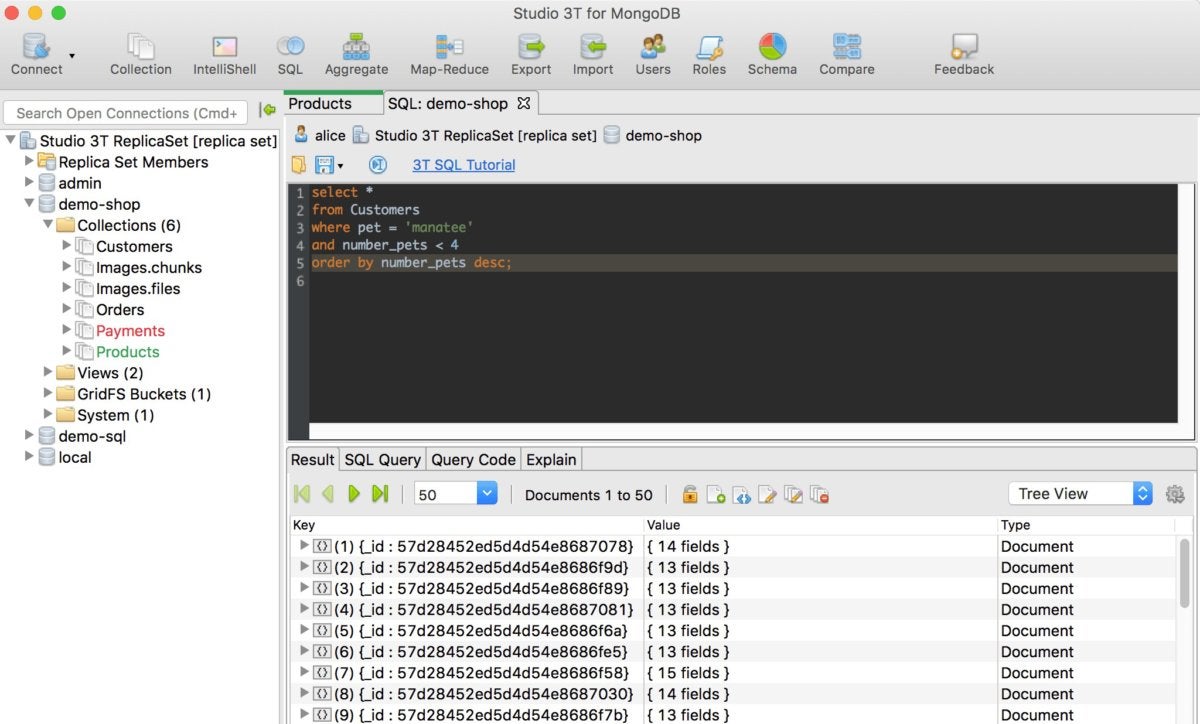
    Studio 3T’s SQL-query UI.

     IDG
    Studio 3T’s code-generation UI.

    As you would expect, Studio 3T’s product lets you query MongoDB in several ways: with a visual query builder, using the MongoDB query language, and using SQL. You can edit the values in place and generate code using any of these methods.

    Studio 3T fills out code-generation part of the feature set with a MongoDB console with auto-complete.

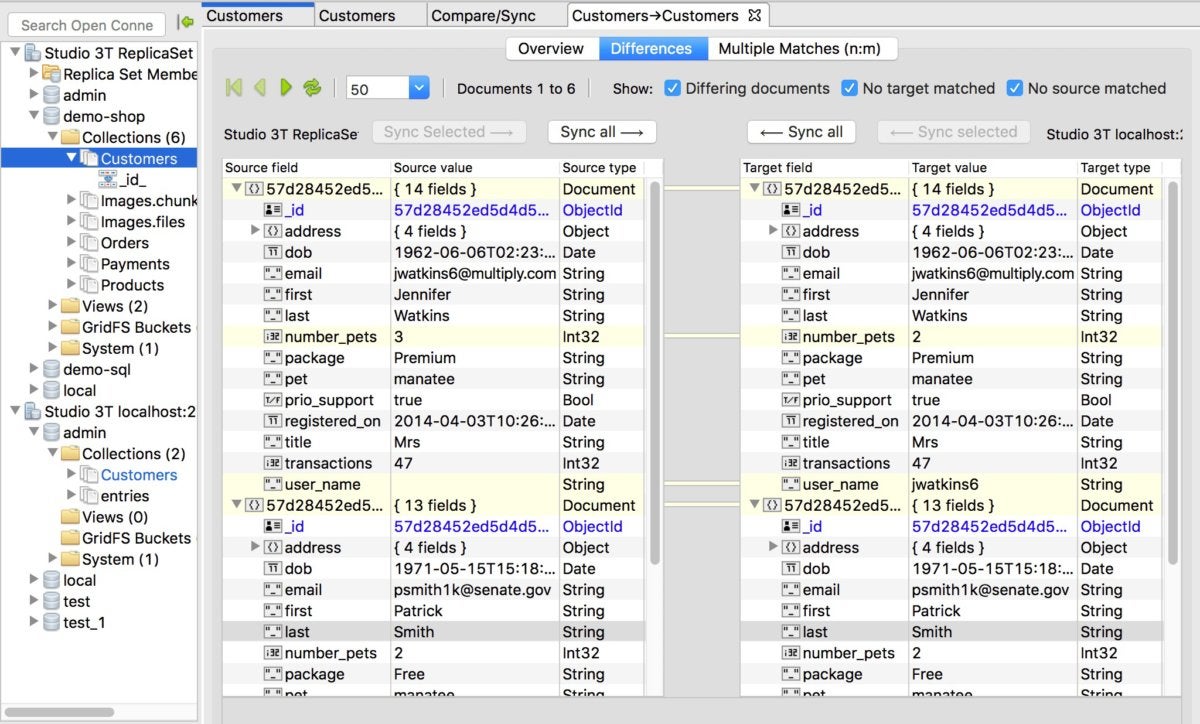
    If you’re looking for a more modern answer to Toad for MongoDB, Studio 3T might be your Huckleberry. Studio 3T provides tools for Schema exploration and comparison. It also provides similar functionality for data comparison. That means it can look at two different instances, such as dev and prod, and determine the answer to that age old question “What’s the difference?”

     IDG
    Schema exploration in Studio 3T.

     IDG
    Schema comparison in Studio 3T.

    For administrators, Studio 3T offers operations monitoring charts.

      IDG
    An operations-monitoring chart in Studio 3T.

  4. #924
    Reply in Chat & Socialize

    Data remains a foundational element of computing. Recently, Hadoop and big data have been a central part of data progression, allowing you to capture data at scale. But companies now look to the expanding use of cloud computing and machine learning to create more intelligent applications.

    This new generation of applications use all the data they can, including incoming real-time data, to respond in the moment to changing circumstances and formulate advantageous outcomes. This includes delivering on the digital transformation promise sought by companies to deliver rich customer experiences.

    Intelligent applications can converge database and data warehouse workloads, allowing companies to respond and react to changing conditions in real time.

  5. #925
    Reply in Chat & Socialize

    “The right tool for the right job.” If such wisdom holds true anywhere, it certainly holds true with the choice of database a developer picks for a given application. Document databases, one of the family of data products collectively referred to as “NoSQL,” are for developers who want to focus on their application rather than the database technology.

    With a document database, data is not stored in tables with distinct column types. Instead, it is stored in freeform “documents” with any number of fields and any number of nested structures. Such documents are typically represented as JSON, and updated either by way of APIs or by sending JSON to a REST endpoint. Most every modern programming language supports JSON and REST, so working with a document database feels more like working natively with those data structures than working with a traditional database.

    [ Which NoSQL database should you use? Let InfoWorld be your guide. NoSQL grudge match: MongoDB and Couchbase Server go nose to nose. • NoSQL standouts: The best key-value databases. | Keep up with the hottest topics in programming with InfoWorld’s App Dev Report newsletter. ]
    This schemaless design, as it is called, has its limitations. A developer must do more work to ensure that inserted data is consistent, because such consistency isn’t always guaranteed by the database itself. SQL, the standard-issue and widely understood language for database work, isn’t supported by most document databases, so those with existing database expertise must start from scratch. But the convenience, speed, scalability, and versatility of a document database is hard to beat when you’re writing an application that needs a protean, free-form data structure.

    Here we’ve profiled seven of the best known and most widely used document databases. Four of the seven—CouchDB, Couchbase Server, MongoDB, and RethinkDB—are open source projects with few or no practical barriers to getting started; Couchbase and MongoDB are also available in supported enterprise editions under commercial licenses. The other three—Amazon DynamoDB, Google Firebase, and IBM Cloudant—are hosted services from major cloud vendors, where close integration with other services in those clouds is a big draw.

  6. #926
    Reply in Chat & Socialize

    Even in the so-called modern web application, AJAX HTTP requests fly back and forth between the client and server layers, moving data in both directions. HTTP requests, under the guise of REST protocols, also serve as the transport between some databases and the server application layers.

    WebSockets have been around for years now, and they have wide client-side support at this point. The best part is that, whereas HTTP is a request/response protocol, WebSockets support full-duplex communication, allowing clients and servers to send and receive data at the same time.

    [ Which NoSQL database should you use? Let InfoWorld be your guide. NoSQL grudge match: MongoDB and Couchbase Server go nose to nose. • NoSQL standouts: The best key-value databases. • NoSQL standouts: The best document databases. | Go deep into analytics and big data with the InfoWorld Big Data and Analytics Report newsletter. ]
    WebSockets can be used for peer-to-peer communications between clients, but they are most often used for pushing data to and from a server. WebSockets open up a whole new world of less structured applications than would be possible using only request/response HTTP transports.

    Most architectures are still request/response, however. Databases—Redis included—work in a request/response fashion (with the exception of special mechanisms like Pub/Sub, of course). Even computational activities are request/response in nature: You send data in and wait for data to come out. Applying request/response to a full-duplex transport like WebSockets presents some tricky challenges.

     
    Now, this often isn’t a problem if the server handling the requests just does something internally with a Node.js script. Node.js is single-threaded, and because there is very little resource overhead to responding to a WebSocket event, the server generally handles the flood of events without issue. The problem arises when managing this type of traffic using an external request/response service, which you’ll find in most stacks these days.

    In this article, we’ll explore the problem of managing requests and responses in the context of full-duplex communication (WebSockets), and illustrate how to cope with it using an example application built with Node.js and Redis.

    Managing request/response traffic at full-duplex

    A common pattern used to achieve request/response over a full-duplex transport is to assign each request an ID (most often randomized). The “conversation” can be thought of like this (not accounting for acknowledgements):

    Client: This is request #1: I want to know the price of Item #400.
    Server: Request #1, your response is $4

    Easy, right? 

     
    Well, what happens when your client requests many things at one time?

    Client: This is request #1: I want to know the price of Item #400.
    Client: This is request #2: I want to know the price of Item #380.
    Client: This is request #3: I want to know the price of Item #385.

    … 

    [before server can respond]
    Client: This is request #200,000: I want to know the price of Item #999999.

    We need a way to regulate these requests so that the server can process them on its own time.

    On the packet level, such a solution is referred to as packet shaping, in which networks delay identified packets to improve overall quality of service or achieve some other objective. When applied to higher-level requests like WebSockets, this pattern is known as traffic shaping. Traffic shaping, and a related operation, metering, are fundamental needs of high-volume services.

    Let’s say we have a simple microservice that takes pricing requests and gives prices. This service is capable of handling 1,000 pricing requests per second, but beyond that stability is risked. Your normal traffic makes about 500 pricing requests per second, so a ceiling of 1,000 is just fine. Your previous architecture wasn’t as quick and had built-in limits that slowed things significantly as you approached the pricing request service limits, but by employing WebSockets, you’ve reduced the HTTP header overhead and network latencies while improving overall speed. Unfortunately, you’ve also introduced a situation where the stability of your service is at risk—the pricing request is now your bottleneck. 

    What you need is a way to programmatically delay those requests. If the pricing service is keeping up with the requests coming in, you want minimal to no impact. When a flood of requests comes in that is beyond the capacity of the pricing service, you want to delay the requests. Ideally, this would not be a “brick wall” of a delay, but one that gradually increases as you approach the limit.

    Because WebSockets are full-duplex, having a delayed response will incur little to no cost to the client side (aside from the intentional delay). Conversely, most browsers limit HTTP requests significantly. On the server side, the delay incurs some memory cost while the request is being held, but it’s minimal. Effectively, we need to count the number of in-progress requests and delay incoming requests as needed.

    Traffic shaping WebSockets: Enter Redis

    Redis has a number of strengths we can leverage in our solution to protect our service against an overwhelming spike in requests:

    • Low-overhead and low-latency protocol

    • Variety of structures that can be directly manipulated

    • Can be distributed, clustered, and persisted

    • Able to handle many connected clients

    These strengths make Redis a good fit for our counting needs. Let’s step through the process of accepting and responding to a WebSocket request.


    1. Client: This is request #1: I want to know the price of Item #400.

    2. [Server accepts message, looks up how many requests are in-progress, and increments the count by one. The new in-progress count is then used to calculate the delay.]

    3. [Server initiates delay, calculated in step 2]

    4. [Server gets data from pricing service]

    5. Server: Request #1, your response is $4

    6. [Server reduces count of in-progress request by one]

    Redis would be used in steps 2 and 6 in this description, acting as a distributed counter. The request to the pricing server would not be made until after the delay, and if calculated correctly, would prevent an onslaught of traffic killing the pricing service. We’re not actually serving in a series but we are allowing some concurrency in the full-duplex requests. Because we’re using Redis to keep track of the counter, this would operate within a stateless environment (behind a load balancer/proxy to any number of Node.js instances).

    To calculate the delay in sending the request to the pricing server in our example, we’ll use a singular variable: the number of delays not yet resolved. With this variable, you can create your own traffic shape.  For example, let’s say that you want to be able to handle the first three requests with no delay then linearly increase your delay by 50 milliseconds:

    function(currentCount) {

       return currentCount <= 3 ? 0 : (currentCount-3) * 50;

    }

    So, if currentCount is less than three, immediately respond (0ms delay). Otherwise, delay each additional request by 50ms. For example:

    Request 1: 0 delay

    Request 2: 0 delay

    Request 3: 0 delay

    Request 4: 50ms delay

    …

    Request 10: 350ms delay

    …

    It is important to understand that these numbers represent the current delay. As requests are responded to, the currentCount is decremented accordingly. Take this for example:

    Request 10: 350ms delay (currentCount = 10)
    Request 9 delay is resolved (currentCount = 9)

    Request 11: 350ms delay (currentCount = 10)

    Let’s take another example. In this situation, we’ll work with batches of three requests at a time:

    function(currentCount) {

       return Math.floor(currentCount / 3) * 50;

    }

    As with the previous example, the first three request have no delay, but requests four through six would have the same delay (50ms), requests seven through nine would have the same delay (100ms), and so on. 

    As you can imagine, you could be very creative in approaching the shape of incoming traffic.

    The other thing to keep in mind is that, in this situation, we’re working with zero knowledge of the state of the pricing server. Our delays are based only on the number of in-progress delays. In many situations this might work fine, but it’s also possible to create complex functions that bring in data from other sources such as network traffic, CPU load, network health, user plans/tiers, etc. Each of these variables can be reported into Redis and then your traffic shaping application can perform the calculations accordingly.

    Traffic shaping WebSockets: Node.js-Redis example app

    Simulating an entire network and traffic on a single machine is fraught with challenges. So let’s set up some limits:

    • A loopback interface is fast. The delays are intentionally set high so we can see what is going on. In production, your delays would be much smaller (and your traffic much larger).

    • To better visualize and contain the example, we are limiting the number of different resources being shaped.

    • While you would normally get traffic in a natural, consistent pattern, our simulation interface is limited to four “phases” that represent bursts of traffic. 

    The example application is a small Node.js/Express server. (You can download the code for this application at https://github.com/stockholmux/redis-traffic-shape.) To get started you’ll pass in a Node_Redis connection object in a JSON file to your server, like this:

    $ node socket-shape.node.js --connection ../connection.json

    This will launch an HTTP server at port 9000 and a WebSocket server at port 8855. (You can change these with the command line arguments httpport and wssport respectively.) Point your browser at http://localhost:9000. Thiswill also start us out with a simple linear delay logic wherein each item is delayed based on the number of active delays (portrayed as a diagonal line pointing up and to the right on multiple requests).

     Redis Labs
    This little dashboard might seem a bit daunting at first, but it’s just a way to visualize what’s going on with the delays. At the left is a graph that will plot the sequence of requests on the x axis and the delays on the y axis. On the right is the table output of the same data. The Resource column value correlates with the red buttons — these are independent cumulative delays. So, requesting 1 many times will only make additional requests to 1 further delayed. The Status column reports the query status, which is  either started or finished. The Round Trip column indicates the time elapsed between the request being sent and the response (roughly equating to the delay). The Finish column lists the time elapsed between clicking the Play button and the completion of the request. Finally, the Phase column represents which burst the request was sent out in. 

    The Play button will send out the bursts as specified in the buttons below. The Reset button zeros out the requests. The next three buttons are canned request patterns: 

    • Traffic -> 1 destination fills each burst phase with 10 copies of one resource. In short, it will request the same resource 40 times, split into four phases.

    • Traffic -> All destinations fills burst phases 1 through 3 with 10 copies of resources 1 through 3 (respectively).

    • Traffic -> Mixed destinations fills each phase with equal numbers of resources 1 through 3 (20 total in each phase).

    Finally, you have each burst phase in separate columns. The red buttons represent an action that will be sent in a burst. Each item will be sent in order, but it won’t wait for a response. If you put 10 items in, then all 10 items will be sent as rapidly as possible once the Play button is pressed. If you’ve ever played with a drum machine, this interface works similarly (without the repeating or never-ending racket).

    Let’s look at the operation. We’re operating in linear mode (which is the default). I’ll load the burst phases up by clicking the “Traffic -> 1 destination” button and pressing Play. Here is the resulting graph:

     Redis Labs
    Note the characteristic sawtooth pattern. The dips are due to the burst phases being 500ms apart, during which time all the delays have finished.

    Let’s examine the next pattern. You can press the Reset button (or just reload the page) and use the “Traffic -> All destinations” button to populate the burst phase columns. Now press Play and you should get something that looks like this:

     Redis Labs
    The different colors represent the different resources. Notice how the requests for each resource are issued serially. That is, the requests for different resources are not interfering with one another.

    Reset the dashboard again and let’s check out the final pattern “Traffic -> Mixed destinations.”  This graph looks a lot like the first, but illustrates how each resource is counted independently, apart from the others:

     Redis Labs
    You might notice that the lines don’t perfectly match up. This is a side effect of a few things:

    • Since the traffic generator is being run on the same machine as the web browser, server process, and Redis process, you’re likely seeing some resource fighting already — either on the loopback or in the system as a whole.

    • js is a “garbage collected” language. It’s possible that GC is occurring at some point during accepting or responding to these messages.

    • The script is relying on both setTimeout and setInterval, which often lack precision (a lesson that is hard learned if you’ve ever tried to coordinate animations on the front end).

  7. #927
    Reply in Chat & Socialize

    There has been a lot of hype recently about graph databases. While graph databases such as DataStax Enterprise Graph (based on Titan DB), Neo4, and IBM Graph have been around for several years, recent announcements of managed cloud services like AWS Neptune and Microsoft’s addition of graph capability to Azure Cosmos DB indicate that graph databases have entered the mainstream. With all of this interest, how do you determine whether a graph database is right for your application?

    What is a graph database?

    Before we go any further, let’s define some terminology. What is a graph database? Think of it in terms of the data model. A graph data model consists of vertices that represent the entities in a domain, and edges that represent the relationships between these entities. Because both vertices and edges can have additional name-value pairs called properties, this data model is formally known as a property graph. Some graph databases require you to define a schema for your graph—i.e. defining labels or names for your vertices, edges, and properties prior to populating any data—while other databases allow you to operate without a fixed schema.

    As you might have noticed, there isn’t any new information in the graph data model that we couldn’t capture in a traditional relational data model. After all, it’s simple to describe relationships between tables using foreign keys, or we can describe properties of a relationship with a join table. The key difference between these data models is the way data is organized and accessed. The recognition of edges as a “first class citizen” alongside vertices in the graph data model enables the underlying database engine to iterate very quickly in any direction through networks of vertices and edges to satisfy application queries, a process known as traversal.

    [ Which NoSQL database should you use? Let InfoWorld be your guide. NoSQL grudge match: MongoDB and Couchbase Server go nose to nose. • NoSQL standouts: The best key-value databases. • NoSQL standouts: The best document databases. | Go deep into analytics and big data with the InfoWorld Big Data and Analytics Report newsletter. ]
    The flexibility of the graph data model is a key factor driving the recent surge in graph database popularity. The same requirements for availability and massive scale that drove the development and adoption of various NoSQL offerings over the past 10 or so years are continuing to bear fruit in the recent graph trend.

     
    How to know when you need a graph database

    However, as with any popular technology, there can be a tendency to apply graph databases to every problem. It’s important to make sure that you have a use case that is a good fit. For example, graphs are often applied to problem domains like:

    • Social networks

    • Recommendation and personalization

    • Customer 360, including entity resolution (correlating user data from multiple sources)

    • Fraud detection

    • Asset management

    Whether your use case fits within one of those domains or not, there are some other factors that you should consider that can help determine if a graph database is right for you:

    • Many-to-many relationships. In his book “Designing Data Intensive Applications” (O’Reilly), Martin Kleppmann suggests that frequent many-to-many relationships in your problem domain is a good indicator for graph usage, since relational databases tend to struggle to navigate these relationships efficiently.

    • High value of relationships. Another heuristic I’ve frequently heard: if the relationships between your data elements are just as important or more important than the elements themselves, you should consider using graph.

    • Low latency at large scale. Adding another database into your application also adds complexity to your application. The ability of graph databases to navigate through the relationships represented in large data sets more quickly than other types of databases is what justifies this additional complexity. This is especially true in cases where a complex relational join query is no longer performing and there are no additional optimization gains to be made to the query or relational structure.

  8. #928
    Reply in Chat & Socialize

    Oracle isn’t normally one to expose its fetishes, but the company’s fixation on Amazon Web Services has become glaringly, disturbingly obvious. Whether at OpenWorld, in analyst briefings, or on Twitter, Oracle can’t seem to talk about anything else. Two years ago Oracle peddled the myththat “AWS is 20 years behind Oracle,” even as AWS boasts 80 times more IaaS revenue and 10 times more PaaS revenue than Oracle, according to Gartner data. More recently, Oracle chairman Larry Ellison, in a “pot calling the kettle black” moment, dissed Amazon Redshift as “inflexible and expensive.”

    Even more recently, Oracle’s database chief, Andy Mendelsohn, pilloried AWS databases as underpowered for enterprise workloads. If your only ambition is to run “small, departmental databases with decent performance,” Mendelsohn crowed, AWS is adequate. But “If you want to run the biggest, baddest enterprise workloads, they can’t run on Amazon.” This is ridiculously false; AWS has had scores of enterprises on the record embracing AWS databases for their most mission-critical needs. But perhaps Oracle still desperately wants to believe it.

    [ Which NoSQL database should you use? Let InfoWorld be your guide. NoSQL grudge match: MongoDB and Couchbase Server go nose to nose. • NoSQL standouts: The best key-value databases. • NoSQL standouts: The best document databases. | Go deep into analytics and big data with the InfoWorld Big Data and Analytics Report newsletter. ]
    Indeed, Oracle needs this to be true because, as Gartner analyst Merv Adrian told me, rival databases are starting to put the hurt on Oracle, with AWS the biggest threat by far. But it’s not true.

    Oracle’s database business is deteriorating

    Originally the biggest threat to Oracle’s database dominance seemed to come from the NoSQL crowd, given how data has changed over the past ten years. For decades, the traditional relational database, with its assembly of data into neatly ordered rows and columns, served us well. As data volumes, variety, and velocity changed (the so-called three V’s of big data), the venerable RDBMS seemed outdated.

     
    Perhaps it is, but that doesn’t mean enterprises can afford a rush to the exits in favor of the flexible schema that NoSQL offers. As Adrian puts it, “When someone has invested in the schema design, physical data placement, network architecture, etc. around a particular tool, that doesn’t get lifted and shifted easily, something that Gartner calls ‘entanglement.’” As nice as “rip and replace” may sound, once an enterprise has bolted dozens of systems to a particular database, replacing that database may also mean replacing some or many of those interconnected systems.

    And doing that is simply too painful. “The greatest force in legacy DBMS is inertia,” Adrian concludes.

    But for new applications NoSQL databases specifically and cloud databases in general are having a moment that keeps going and going and going. In 2011, the top five database vendors—Oracle, Microsoft, IBM, SAP, and Teradata—owned 91 percent of DBMS revenue. By 2016, that number was down to 86.9 percent. Although that doesn’t seem like a precipitous drop, the database market is worth roughly $34 billion. A drop of a few percentage points is a very big deal, and it involves lots of cash.

    Oracle, for its part, has shed market share points every year since 2013, Adrian notes. Yes, that share is still about 40 percent, which is roughly double that of second-place Microsoft. But the difference is that Microsoft’s share has grown every year during that same period. Oh, and AWS? AWS is “roaring up the charts,” Adrian noted, while “IBM is dropping precipitously.”

     
    No, we’re not going to see Oracle’s database revenue fall off a cliff. But that might not be because its customers remain committed to the database leader. Instead, they may simply continue to pay for stuff they don’t actually use. As a recent Rimini Street survey showed, as much as 74 percent of Oracle customers are running unsupported, with half of Oracle’s customers not sure what they’re paying for. These customers are likely paying full-fat maintenance fees for no-fat support (meaning they get no updates, fixes, or security alerts for that money).

    These aren’t behaviors of companies that are committed to the Oracle value proposition. They’re just conditioned to write that check.

    Except, of course, for new applications.

    For new applications, NoSQL and AWS are getting the action

    For those new applications, non-cloudy NoSQL is taking a significant chunk of business, Adrian underlined. Nonrelational databases like MarkLogic and MongoDB now generate $268 million in revenue each year, a number that is “growing nicely” in the mid double-digits. If you add in Hadoop vendors, that nonrelational number jumps to $1.5 billion, or 4.5 percent of the DBMS market. Nonrelational databases, in other words, have “hit escape velocity,” Adrian argues.

    This, however, is not enough to strike fear into Oracle. The largest, fastest-growing of the nonrelational vendors—Cloudera—could hit 40 percent growth each year for a few years and would still take years to get to $1 billion. That’s significant, but it’s not AWS—which, again, is “roaring up the charts.”

    Which is why Oracle fears AWS, and rightly so.

    Ovum analyst Tony Baer describes Oracle’s cloud strategy as “Cloud 2.0.” Despite being so late to the cloud party, Oracle now wants us to believe that it can learn from the mistakes of AWS, Microsoft Azure, and others to leapfrog them all. This is complete and utter nonsense. Not only is Oracle ill-suited to actually build a next-generation cloud database, because it has no experience running cloud applications at scale (unlike Amazon, Microsoft, and Google, which have that experience baked into their DNA), but Oracle’s volume and velocity of cloud investments lag AWS by dozens of datacenters and years, not months.

    Meanwhile, AWS’s database products are its fastest-growing services. Most of this database adoption is for new applications (which are growing dramatically faster than old-school, Oracle-inclined applications). But AWS CEO Andy Jassy has also announced more than 50,000 database migrations, much of them from Oracle.

     
    Oracle is a fantastic database for yesteryear’s enterprise applications, but it is a poor fit for modern, big data applications. For these, Amazon will continue to gobble Oracle’s market share, $1 billion at a time. This will lead Oracle to fixate even more on AWS, but that fixation doesn’t seem to be fixing the problem.

  9. #929
    Reply in Chat & Socialize

    MongoDB will add multidocument ACID transactions support to its NoSQL database of the same name. Multidocument ACID transactions support has been the most-requested feature sought for MongoDB, said Seong Park, MongoDB’s vice president of strategy and product marketing.

    Multidocument support is planned for MongoDB 4.0, which is due this summer and reached beta stage this week. ACID transactions already have been supported at the document level in the database; now they can be done across documents as well as across collections within MongoDB. Collections in MongoDB are analogous to a table in a relational database.

    [ The essentials from InfoWorld: NoSQL grudge match: MongoDB vs. Couchbase Server • Review: MongoDB learns cool new tricks • The essential guide to MongoDB security. • How to work with MongoDB in .Net. | Go deep into analytics and big data with the InfoWorld Big Data and Analytics Report newsletter. ]
    With multidocument ACID transactions support, develoerps coudl enable many-to-many data relationships. An order management system, for example, might have a transaction affecting five items, which needs to be reflected in the inventory system; this would be handled by MongoDB 4.0 without developers having to write code. The new capability should make transactions have a look and feel similar to what developers have been familiar with in relational databases. The company says multidocument transaction support will not affect performance in MongoDB 4.0 for workloads that do not need them.

  10. #930
    Reply in Chat & Socialize

    Neo4j is both the original graph database and the continued leader in the graph database market. Designed to store entities and relationships, and optimized to perform graph operations such as traversals, clustering, and shortest-path calculations, Neo4j shines at exploring data that consists of huge numbers of many-to-many relationships.

    To understand why graph databases are different and sometimes desirable, we need to go back in time. Early databases were little more than indexed file systems for sequential records (ISAM) with fixed field layouts. Soon databases started expressing hierarchical relationships, such as departments belonging to divisions. Then they captured networks using sets with 1:n relationships; you could traverse the sets programmatically. The standard for the network database model was first issued by CODASYL in 1969.

    When relational databases were first introduced, in the early 1970s, they were roughly half as fast as CODASYL databases, because of the overhead of the SQL query processor, especially when joining related tables. Fortunately computer hardware was becoming faster — Moore’s Law observed that the density of components on a circuit board was doubling every two years. That observation held for decades.

  11. #931
    Reply in Chat & Socialize

    Developers should be burning with excitement about the opportunities ahead in 2018, with products and tools around technologies such as blockchain, chatbots, serverless functions, and machine learning becoming mature enough for real-world projects. At the same time, many developers will be worried about holding up against the pressure to deliver code and functionality faster without compromising security or performance. But there is good news on that front as well.

    For developers, 2018 will be defined by this tension between seizing transformative new opportunities while coping with the pressure to do more, with higher quality. Below are 10 predictions related to how those forces will play out in the year ahead.

    [ Are you ready for the container invasion? Learn how to get started with Kubernetes. | Keep up with the latest developments in cloud computing with InfoWorld’s Cloud Computing newsletter. ]
    1. B2B transactions leveraging blockchain go into production

    Businesses have begun to understand the security, reliability, and efficiency to be gained from blockchain-enabled transactions. Developers will implement many blockchain use cases across financial services and manufacturing supply chains in the coming year. Blockchain is a technology that enables efficient, secure, immutable, trusted transactions among organizations that might not fully trust each other, eliminating intermediaries.

    Consider a company ordering products from an offshore manufacturer. These products get shipped via a shipping company, come through customs, through another shipping company, and finally to the buyer. Today, the verification and reconciliation of each step mostly happens through emails and spreadsheets, with a lot of people and processes involved. Blockchain eliminates manual processes and reconciliation by irrevocably recording updates to the blockchain ledger when a minimum number of parties say, “Yes, this part of the transaction happened.”

     
    Blockchain cloud services will bring scalability, resiliency, security, and pre-built integrations with enterprise systems, making it much easier for developers to focus on the business use case as opposed to underlying hyperledger fabric implementation.

    2. Chatbots routinely have real conversations with customers and employees

    People are getting tired of needing multiple mobile apps to do the same job—like three different airlines apps with different ways to check in and get a boarding pass. A better way is to provide that same functionality but via the most popular app on your phone—messaging. Messaging has three attractive elements consistent across the medium: instant, expressive, and conversational – no training needed. Thanks to advances in artificial intelligence and natural language processing, people will use Facebook Messenger, Slack, WeChat, WhatsApp, or a voice assistant like Amazon Alexa or Google Home, to ask questions and get answers from intelligent bots.

    Developers, using new intelligent bot-building cloud services, can quickly craft bots that understand the customer’s intent, maintain conversational state, and respond intelligently while making integration with back-end systems easy. Imagine taking a picture of a dress you saw in a movie and messaging the image to your favorite clothing store’s bot, which uses image recognition and AI to recommend similar dresses. Employees could also be huge beneficiaries of bots for tasks such as asking how many vacation days they have left, filing a help desk ticket, or ordering a replacement laptop, where the system even knows which laptops the employee is eligible for and can provide status updates on their order. Given it is much more forgiving to experiment with your own employee base, developers might first leverage their bot-building chops to build and test employee-facing bots.

    3. The button disappears: AI becomes the app interface

    AI becomes the UI, meaning that the synchronous, request-response model of using apps and services gradually disappears. Smartphones are still “low IQ,” because you have to pick them up, launch an application, ask for something to be done, and eventually get a response. In a new generation of intelligent apps, the app will initiate interactions via push notifications. Let’s take this a step further where an app, bot, or a virtual personal assistant using artificial intelligence will know what to do when, why, where, and how. And just do it. Two examples:


    • Expense approvals app watches your pattern of approving expense reports, starts to auto-approve 99 percent of expense reports and only brings to your attention the rare report that requires your attention.

    • Analytics app understands the underlying data, questions asked so far by the business user, questions asked of the same dataset by other users in the company, and each day provides a new insight that the analyst might not have thought of. As organizations gather more data, AI can help us learn what questions to ask of the data.

    Developers need to figure out what data is really important to their business application, how to watch and learn from transactions, what business decisions would most benefit from this kind of proactive AI, and start experimenting. Embedded AI can predict what you need, deliver info and functionality via the right medium at the right time, including before you need it, and automate many tasks you do manually today.

    4. Machine learning takes on practical, domain-specific uses

    Machine learning is moving from the realm of obscure data science into mainstream application development, both because of the ready availability of pre-built modules in popular platforms, and because it is so useful when dealing with analysis across large, historical datasets. With machine learning, the most valuable insight comes with context — what you’ve done before, what questions you’ve asked, what other people are doing, what’s normal versus anomalous activity.

    But to be effective, machine learning must be tuned and trained in a domain-specific environment that includes both the datasets it will analyze and the questions it will answer. For example, machine learning applications designed to identify anomalous user behavior for a security analyst will be very different from machine learning applications designed to optimize factory robot operations, which may be very different from those designed to do dependency mapping of a microservices-based application.

    Developers will need to become more knowledgeable about domain-specific use cases to understand what data to gather, what kinds of machine learning algorithms to apply, and what questions to ask. Developers will also need to evaluate whether domain-specific SaaS or packaged applications are a good fit for a given project, given the fact that large quantities of training data are required.   

    Using machine learning, developers can build intelligent applications to generate recommendations, predict outcomes, or make automated decisions. 

    5. DevOps moves toward NoOps

    We all agree devops is critically important for helping developers build new applications and features fast, while maintaining high levels of quality and performance. The problem with devops is developers needing to spend 60 percent of their time on the ops side of the equation, thus cutting into the time devoted to development. Developers are having to integrate various continuous integration and continuous delivery (CICD) tools, maintain those integrations, and constantly update the CI/CD tool chain as new technologies are released. Everyone does CI, but not too many people do CD.  Developers will insist on cloud services to help the pendulum swing back to the dev side in 2018. That will require more automation for real CICD.

    Docker gives you packaging, portability, and the ability to do agile deployments. You need CD to be a part of this Docker lifecycle. For example, if you are using containers, as soon as you commit a code change to Git, the default artifact built should be a Docker image with the new version of the code. Further, the image should automatically get pushed into a Docker registry, and a container deployed from the image into a dev-test environment. After QA testing and deployment into production, the orchestration, security, and scaling of containers should be taken care of for you. Business leaders are putting pressure on developers to deliver new innovations faster; the devops model must free up more time for developers to make that possible.

    6. Open source as a service accelerates consumption of open source innovation 

    The open source model remains one of the best engines of innovation, but implementing and maintaining that innovation is often too complex. For example:


    • You want a streaming data/event management platform, so you turn to Kafka. As you start leveraging Kafka at scale, you must set up additional Kafka nodes and load balance large Kafka clusters, update these clusters as new releases of Kafka come out, and then integrate this service with the rest of your environment.

    • You want Kubernetes for container orchestration. Instead of taking care of upgrades, backups, restores, and patches for your Kubernetes cluster, the platform should do all of that for you. Kubernetes ships every six weeks, so the platform should have rolling deployments and self-healing.

    • You want Cassandra for NoSQL databases. You should want the backup (incremental or full on a schedule), patching, clustering, scaling, and high availability of the Cassandra cluster to be managed by the platform.

    Developers will increasingly look for cloud services to deliver all of that high-speed innovation from open source while taking care of operational and management aspects of these technologies.

    7. Serverless architectures go big in production

    The appeal of serverless architectures is clear: When there is demand for my code to be executed based on a certain event, infrastructure is instantiated, my code is deployed and executed, and I am charged only for the time my code runs. Let’s say you want to build a travel booking function to book/cancel flights, hotels, and rental cars. Each of these actions can be built as a serverless function written in different languages such as Java, Ruby, JavaScript, and Python. There is no application server running with my code on it; rather the functions are instantiated and executed on infrastructure only when needed.

    For developers, stringing serverless functions together to execute complex transactions creates new challenges: describing how these functions should be chained together, debugging distributed transactions, and determining how, on failure of one function in a chain, to create compensating transactions to cancel inappropriate changes. Look for cloud services and open source tools, like the FN project, to flourish by helping developers to easily manage the programming, composition, debugging, and lifecycle management of serverless functions, and to deploy and test them on a laptop or on-prem server or any cloud. The key is going to be picking a serverless platform that provides maximum portability.

    8. The only question about containers becomes “Why not?”

    Containers will become the default for dev/test work and commonplace for production applications. Expect continued improvements in security, manageability, orchestration, monitoring, and debugging, driven by open source innovations and industry standards. Containers provide the building blocks for many of the trends driving modern development including microservices architectures, cloud-native apps, serverless functions, and devops.

    Containers won’t make sense everywhere —for example, when you need a more prescriptive cloud platform, such as an integration PaaS or a mobile PaaS—but these higher level cloud services will themselves run on containers, and will be the exceptions that prove the rule.

    In addition, software licensing models for high-value, commercial, on-premises software will have to embrace the spread of container adoption. Pricing models for software will have to support “turn on” and “turn off” licensing as containers are instantiated, scaled up, and scaled down.

    9. Software and systems become self-healing, self-tuning, and self-managing

    Developers and production operations teams are drowning in data from logs, web/app/database performance monitoring and user experience monitoring, and configuration. In addition, these various types of data are siloed, so you must bring many people into a room to debug issues. Then there is the issue of knowledge transfer: Developers spend a lot of time telling production ops the ins and outs of their applications, what thresholds to set, what server topologies to monitor for a transaction, and so on.

  12. #932
    Reply in Chat & Socialize

    AFLĂ DACĂ AI PROCESORUL AFECTAT MELTDOWN SAU SPECTRE

    Vulnerabilitățile Meldown și Spectre afectează TOATE procesoarele din lume, indiferent de sistemul de operare.

    In ultimele zile presa internaționala a început sa vuiască pe marginea subiectului vulnerabilităților Meltdown și Spectre, descoperite în procesoarele Intel AMD și ARM.


    Varianta corecta!

    Adevarul este ca cei de la intel o vulnerabilitate serioasa pe toate procesoarele fabricate în ULTIMII 10 ANI…. ULTIMII 10 ANI ????

    Zilele astea iese informația la suprafața; de ce? Pentru ca era o lovitura prea grea și greu de suportat, și probabil au așteptat sa găsească ceva și la AMD sau ARM, ca … împartă pagubele cu ei. Nu-i o chestie personala, e doar propaganda și marketing.


    Cât de afectate sunt procesoarele?

    INTEL iese cel mai afectat din acesta situație, deoarece are și cea mai grea vulnerabilitate, care este imposibil de reparat, deoarece este hardware.


    Cum adică vulnerabilitate hardware?

    Se pare ca intel a lăsat intenționat niște portițe deschise în procesoarele lor, și chiar “ambuscade instalate în procesor”.


    Intel a instalat sisteme de operare în procesor ?

    Va vine sa credeți sau nu, pe procesoarele intel este instalat în sistem de operare care poate fi accesat de la distanta si care poate citi datele stocate pe disk-uri.

    Sistemul de operare este unul foarte mic, doar kernel-ul și câteva module. Acest sistem de operare instalat de procesoarele intel se numește MINIX. Madărfacării….!!!


    Cum iti dai seama daca ai Meltdown sau Spectre ? 

    Pe site-ul Intel găsiți un mic soft, cu care puteți detecta prezenta pericolului. link mai jos


    Cum repar procesorul vulnerabil afectat de Meltdown și Spectre ?

    Microsoft a dat drumul unui update care rezolva problema. Dacă nu aveți update-urile pornite, mai jos aveți un link direct de download.

    Linux și macOS vor lansa și ei update-uri, dacă nu cumva au și făcut-o deja.

  13. #933
    Reply in Chat & Socialize

    Cum sa asculți muzica YouTube pe telefon cu ecranul blocat

    În România încă nu a pătruns foarte mult ideea de aplicație de streaming, în care, plătind un abonament, ai acces la muzica din toate genurile pe saturate.

    Ascultăm muzica pe YouTube

    Cam toate lumea asculta muzica, și nu numai, pe YouTube. Acolo se lansează prima oara melodiile, acolo se afla și vlog-urile, care pot fi și ascultate (dacă au substanța).

    Putem spune ca pe YouTube ai mai mari șanse sa găsești ultimele clipuri, decât într-o aplicație de streaming muzica.


    Ecranul pornit consuma bateria telefonului.

    Dacă pornim aplicația youtube, ecranul telefonului va trebui sa fie aprins tot timpul, cât rulează un video, și asta ne rupe baterie telefonului.

    Cum sa asculți muzica de pe youtube cu ecranul telefonului blocat.

    Eu am mai făcut câteva tutoriale video pe tema asta.

    Avem metode diverse:
    metoda 1 (merge si download)
    metoda 2 (bonus video picture in picture)
    metoda 3
    metoda 4

    Cum sa asculți muzica YouTube pe telefon cu ecranul blocat cu Google Chrome

    Metoda de azi este speciala. Ma refer la faptul ca nu avem nevoie de niciun fel de aplicație terța, ca sa ascultam muzica de pe youtube, pe telefon cu ecranul blocat.

    Cu ajutorul browserului Google Chrome, care este prezent aproape pe orice telefon Android și iOS, vom asculta muzica pe youtube cu ecranul blocat sau pe fundal în timp ce jucam un joc sau lucram cu alta aplicație pe telefon.


    Ghid – Muzica YouTube pe telefon cu ecranul blocat în Google Chrome

    1. Deschideți browserul Google

    2. Intrați pe youtube (în browser)

    3. Găsiți melodia sau playlist-ul favorit

    4. Schimbați browserul în modul desktop

    5. Dați play la piesa

    6. In timp ce cânta piesa, întoarceți-va pe homepage

    7. Melodia va opri, dar în bara aveți comenzile play-pause și skip

    8. Apăsați play și gata

  14. #934
    Reply in Chat & Socialize

    Salut prieteni, in tutorialul de astazi o sa invatam cum aplicam un efect de reverse sau cum ii mai spun unii voice dream efect (voci din vis) peste o voce inregistrata. Totul este foarte simplu de realizat, bineinteles daca avem tot ce ne trebuie. Un efect extrem de usor de aplicat dar cu toate acestea are un impact mare pe vocea aplicata, un efect extrem de des intalnit in filme. Acelasi efect despre care o sa invatam astazi cum il aplicam, este folosit la scara larga in filme atunci cand un personaj vorbeste cu cineva in vis. Ca sa facem toate acestea, avem nevoie de renumitul editor audio Audacity despre care noi am mai facut in trecut tutoriale.

    Subiectele abordate atunci au fost: Cum estompam vocea dintr-o melodie mp3 pentru a o folosi la karoke sau Cum lipim mai multe fisiere audio intr-un singur fisier mp3.

    Daca aveti un microfon calitativ, cu atat mai bine, efectul va iesi foarte clar. Totusi am aratat in tutorialul video si un mic truc cu ajutorul caruia puteti curata un fisier audio de zgomotele din fundal. In speranta ca acest tutorial il veti gasi util si distractiv, va invit sa vizionati tutorialul video si nu uitati ca va astept cu comentarii legate de subiect precum si cu parerile voastre despre acest efect audio aplicat pe voce.

    Nu uitati, daca aveti sugestii, reclamatii sau completari nu ezitati sa scrieti pe rubrica de comentarii, de-asemenea daca intilniti pe rubrica de comentarii un user care are o problema si puteti sa-l ajutati, nu ezitati s-o faceti, numai asa putem face locul asta mai bun, ne vedem pe rubrica de comentarii !

    Pe rubrica de comentarii incercati sa ramaneti cat de cat pe subiect, astfel putem oferi si altor vizitatori un tutorial + comentarii relevante, comentariile pot fi un ajutor in plus pentru userul cu probleme sau cu dorinta de a invata.

    Inainte de a pune o intrebare incercati sa cautati printre comentariile mai vechi, de cele mai multe ori exista deja raspuns la intrebarea voastra.

    Folositi mai mult categoriile din partea de sus a site-ului si motorul de cautare din partea dreapta sus pentru a ajunge rapid la ceea ce va intereseaza, avem peste 500 de tutoriale care acopera cam toate genurile de softuri, noi le-am realizat, voi trebuie doar sa le cautati si sa le urmariti.


    Instructiuni de folosire videotutorial.ro

    Motorul de cautare.

    Daca de exemplu aveti o problema cu Yahoo Messenger, puteti introduce in motorul nostru de cautare termeni ca: Yahoo, Mess, Messenger, id mess, multimess, problema messenger, eroare messenger, etc, veti vedea ca o sa aveti de unde alege.


    Categoriile.

    Daca folositi categoriile drop-down, acestea le gasiti pe bara de sub Home cu categoriile: Birou, Grafica-Design, Hardware, Internet, Multimedia, Securitate, Sistem, Stocare-Backup, sub aceste categorii sunt organizate sub-categorii si sub-sub-categorii, asta pentru o filtrare mai precisa. Pentru a gasi ceva legat de Yahoo Messenger cu ajutorul categoriilor va puteti duce pe categoria:Internet, acolo se vor deschide alte subcategorii de unde veti alege Mesagerie-Chat, de acolo va puteti duce pe subcategoria Yahoo, in final, cu ajutorul acestor filtre veti ajunge pe o pagina unde sunt numai articole legate de Yahoo Messenger sau Yahoo Mail.

    Arhivele.

    Pe pagina Arhive puteti gasi toate tutorialele noastre organizate frumos pe zile, saptameni, luni si ani.

    Totul este logic, trebuie doar sa urmati logica.

    Vizionare placuta !

  15. #935
    Reply in Chat & Socialize

    Înregistrare sunet din Windows fără pierderi și fără stereo mix

    Cum înregistrezi sunetul din Windows, de pe PC, la cea mai buna calitate, fără pierderi?

    O metoda pe care eu v-am prezentat-o acum cîțiva ani, implica folosirea unei setări din Windows, care se numește Stereo Mix.

    Din păcate Stereo Mix nu este prezent pe orice PC, și de aceea trebuia sa găsim alta soluție. PC-urle și laptop-urile noi se pare ca nu au Stereo Mix, sau plăcile lor de sunet nu suportă Stereo Mix


    Cum înregistram audio din Windows fără Stereo Mix?

    Soluția era chiar sub nasul nostru în tot acest timp, “ascunsa la vedere” în Audacity și se numește Windows WASAPI, sau Windows Audio Session API.

    Setarea Windows WASAPI face ca la nivelul sistemului de operare sa se poată înregistra sunetul fără niciun fel de pierderi.


    Rezolvarea erorii apăruta pe sistemele cu boxe 5.1

    Dacă aveți sunetul setat pe 5.1, o sa dați peste o eroare. Aceasta eroare poate fi rezolvata foarte ușor prin comutarea pe Stereo (din setările plăcii de sunet).

    Download Audacity, soft de înregistrare, editare și procesare audio!

    Daca vi se pare interesant programul Audacity, avem și alte tutoriale video pe acest subiect.
    Alte tutoriale Audacity (pentru unele aveți nevoie de browser cu flash player):

  16. #936
    Reply in Chat & Socialize

    Ca sa citezi dintr-o sceneta comica: “cărțile te fac neprost”.


    Cine mai citește?

    Cititul s-a schimbat în ultimii ani odată cu apariția internetului, parca am cam uitat de cărți cu nasul în ecrane, din fericire ele, cărțile, tot nu renunța la noi (Întoarcerea cărților). Acum avem la dispoziție o mulțime de informații care parca în ultima vreme au început sa ne cam ducă de nas. Cred ca sunt momente când ai nevoie de consistenta, și atunci internetul nu te ajuta.

    Întoarcerea cărților modernizate.

    Cărțile electronice se întorc în alte haine cu eBook readerele de mana vin sa satisfacă nevoia de portabilitate, reușind sa împletească tehnologia cu plăcerea cititului, ba mai mult, chiar argumentându experiența pe alocuri cu dicționare, formatare text, iluminare, etc, etc.


    Ebook Reader.

    Am luat un Kindle Paperwhite de care sunt extrem de mulțumit. Are cam tot ce-ți trebuie pentru citirea cărților în format electronic. Va recomand fără reținere acest eBook Reader.

    Calibre, un fel de mecanic pentru cărți electronice.

    Programul Calibre este excelent pentru orice tine de cari electronice. De la conversia din Epub în Mobi sau PDF, pana la modificarea sau punerea coperților la cărți electronice, acest program, care e și open source pe deasupra, este excelent.

    Eu l-am folosit ca sa pun coperți la unele cărți electronice gratuite luate de pe net (link mai jos).

    Coperțile pentru cărțile electronice se pot pune individual sau bulk, sau se poate pune o coperta generica, creata de aplicația Calibe, atât cât sa-ți dai seama pe eBook reader care-i titlul cărții și autorul.

    De unde am luat cărți electronice gratuite în limba româna ?

    Am găsit o arhiva de 850 de cărți în format electronic în limba romana, format MOBI.
    Cărți electronice (eBooks) gratuite în limba româna (descarcați torrent dacă le vreți pe toate)

    Dați și voi mai departe la prieteni, pentru ca sunt “cărți care ne fac neproști”

    Preturi Kindle Paperwhite:
    eMag
    Amazon (livreaza si-n România)

    Cum pui coperte la eBook, Kindle Paperwhite, CĂRȚI GRATUITE – tutorial video

  17. #937
    Reply in Chat & Socialize

    Cum oprești publicitatea comportamentala

    De la lupul moralist…

    Publicitatea care ne citește gândurile, sau mai bine zis, istoria din browser.

    Publicitatea clasica (hârtie, radio, tv, afișaj)

    Industria publicității a ajuns departe. Pe TV și radio te manipulează la maxim, cu cuvinte meșteșugite, ton prietenos, șoptit, autoritar sau arogant, sugestii, comparații, etos, patos, logos, etc. Ăștia au câte ceva pentru oricine. Exista chiar și emisiuni la TV, care reușesc sa împacheteze într-un ambalaj frumos aceasta industrie, care de fapt are un singur rol, sa vândă.

    Informațiile legate de produs, care ar putea ajuta consumatorul sa aleagă corect, au dispărut de mult, fiind înlocuite de manipulare.


    Publicitatea online 

    Publicitatea online este însa alt animal. Aici companiile de publicitate au acces la datele noastre și nimic ne le oprește sa le și folosească. Astfel publicitatea nu mai este aruncata în eter, la plesneală, ci este țintita sau “targetata” , cum le place lor sa spună, direct în sinapsele noastre, exact la ținta, în fundul creierul nostru primitiv, care “vreau și io d-aia”. Pentru ca, nu-i asa, trăim doar pentru a ne mai cumpăra câte ceva, și stam ca niște copii cuminți și așteptam curierul…

    O sa se oprească aici publicitatea online ?

    Nu cred, mai ales ca are acces la datele noastre, despre care cei cu neuronii prăjiți spun ca: “io n-am nimic de ascuns”.

    Toți se întreabă, ce fac alții cu datele mele, crezând ca el nu contează. Dacă tu crezi ca datele tale nu sunt importante, afla ca pentru marile companii IT și nu numai, datele noastre sunt ca argintul, puse cap la cap se transforma în AUR și puse la treaba se fac ca DIAMANTUL. Timp în care pentru noi, datele noastre sunt un RAHAT.

    Pornind de la datele noastre se vor face rapoarte, care vor arata ce fel de produse noi ne-ar plăcea sa cumpăram.

    Atunci, noi singuri, inconștienți le vom spune companiilor ce sa ne construiască, sau mai bine zis, vom deveni furnizorul de idei pentru construirea unor produse care încă nu exista, și la care ei nu s-ar fi gândit în veci.

    Asa ca, ai grija de datele tale.

    hai c-am luat-o pe arătura…


    Cum oprești publicitatea comportamentala ?

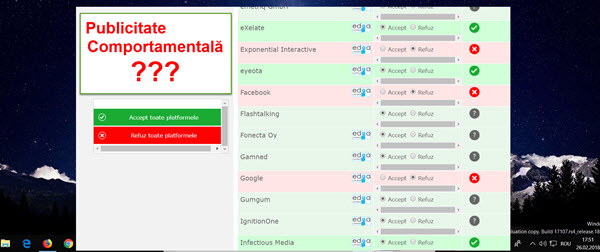
    1. Intrați pe http://www.youronlinechoices.com/ro/optiunile-mele

    2. Apăsați butonul ROȘU “Refuz toate platformele”

    3. Aveți răbdare pana sa opresc toate

    ATENTIE:

    1. Pentru paginile incognito trebuie sa faceți treaba asta fiecare pagina incognito deschisa.

    2. Prin metoda din acest tutorial nu scăpați de publicitate, scăpați doar de anunțurile targetate

  18. #938
    Reply in Chat & Socialize

    Reparare ferestre blurate la rezolutie mare pe Windows (scalare DPI)

    Una din problemele Windows-ului este scalarea incorecta a unor aplicații sau submeniuri în momentul în care se scalează DPI-ul. O sa observam ca imediat ce am mărit DPI-ul la 125%, 150%, 175% sau 200%, aproape toate aplicațiile afișează textul, icoanele și grafica, blurate.


    Ce este scalarea DPI-ului ?

    Scalarea DPI-ului se folosește mai ales pe monitoarele de rezoluție mare. In mod normal pe un DPI de 100%, la un monitor de rezoluție mare, icoanele sistemului de operare, textul, meniurile, etc din sistemul de operare se vor vedea FOARTE MICI.

    Ca sa rezolve probleme cu afișarea prea mica a caracterelor de pe ecran, cei de la Microsoft au pus la dispoziție opțiunea de scalare a DPI-ului. Din păcate aceasta scalare nu da rezultate perfecte de fiecare data, sin în cazul unor aplicații vom vedea imagini blurate în locul unor imagini clare și bine definite, asa cum a trebui sa se vadă pe un ecran de înalta rezoluție.

    Care-i problema mea cu scalarea DPI-ului ?

    Mi-am cumpărat acum ceva vreme un monitor LG 4K foarte bun, care se vede foarte bine. Din păcate în unele momente Windows-ul asta ma dispera cu scalarea lui, care este un fel de zoom digital.


    Rezolvare pentru aplicați, text, meniuri blurate după scalarea DPI.

    Pana la urma am găsit o rezolvare, sau mai bine zis o cârpeala, care rezolva oarecum problema.

    În proprietățile oricărei aplicații avem tab-ul compatibilitate, de unde putem modifica DPI-ul aplicației la 100%, indiferent de ce scalare DPI are sistemul de operare.

    De fapt sunt 3 opțiuni…

    Opțiuni pentru scalare DPI în Windows fără sa afectam aplicațiile.

    Proprietăți aplicație > Compatibilitate > bifați "Suprascrie comportament scalare DPI înalt

    Ce reprezinta fiecare opțiune de scalare DPI în parte?

    Scalare efectuata de:

    1. Aplicatie - aplicatia alege scalarea DPI optima (asta am ales eu)

    2. Sistem - aplicatia este fortata de sistem sa adopte scalarea DPI a lui

    3. Sistem imbunatatit - pentru aplicatiile mai noi in conformitate cu noile standarde Windows

  19. #939
    Reply in Chat & Socialize

    Transformarea vorbirii în text pe calculator – dictare pentru PC


    TTS vs STT

    Dacă data trecuta v-am prezentat Text to Speech, astăzi avem un serviciu de tip Speech to Text, adică transformarea vorbirii în text.

    Transformarea vorbirii în text este extrem de importanta în foarte multe aplicații, dar mai ales în interfața dintre utilizator și un serviciu de tip asistent.


    Transformarea vorbirii în text

    Eu v-am prezentat și acum câțiva acest serviciu de tip Speech to Text, dar intre timp s-a îmbunătățit foarte mult și m-am gândit ca merita din nou atenția noastră.

    Dictation.io

    Este un serviciu gratuit pe care-l puteți folosi din browserul Google Chrome. Dictation se bazează pe recunoașterea vocala a serverelor Google, tocmai de aceea funcționează atât de bine.

    Cât de bine funcționează Speech to Text-ul cu Dictation ?
    Data trecuta serviciul dictation era destul de spartan (acum vreo 5 ani), și nu oferea cine știe ce opțiuni. Acum în schimb avem suport pentru semne de punctuație, comenzi vocale pentru diverse acțiuni și chiar smileys.

    Ce opțiuni interesante are Dictation pentru noi?

    1. Suport pentru limba română

    2. Suport recunoaștere diacritice din dictare

    3. Comenzi vocale pentru paragraf nou, start-stop dictare, etc

    4. Suport pentru semne de punctuație în engleza, dar merge și la dictare în română

    5. Opțiuni de export multiple: clipboard, salvare pe pc, share online, print, etc

    Concluziile mele:

    La transformarea textului în vorbire cu Dictation.io, treaba merge bine dacă pronunți corect și apăsat cuvintele. Dacă adopți un ton mai plictisit, atunci serviciul nu mai recunoaște perfect cuvintele, dar tot le va recunoaște în mare parte. O alta chestie ciudata este ca trebuie sa aștepți pana la scrierea frazei înainte sa rostești comanda pentru semnele de punctuație.

    Nu știu cum va funcționa cu accente regionale (ardelenesc, moldovenesc, etc), aștept părerile voastre.

    La banii ăștia…..(gratis)

  20. #940
    Reply in Chat & Socialize

    Rezolvare probleme în jocuri, înlocuire drivere video.

    Acum câteva luni am avut câteva probleme cu placa video Nvidia GTX860 de pe laptop Acer V Nitro (VN7). In momentul în care rulam orice joc, la vreo 5 minute se bloca imaginea și mouse-ul, iar din difuzoare se auzea un bâzâit enervant. După ce am luat-o prin eliminare cu toate cauzele posibile, am ajuns la concluzia ca driverul pentru placa video era cam dubios. Dar cum sa fie driverul video, când era ultimul disponibil pe site-ul Nvidia ? Doar ultimul driver, e și cel mai bun, nu ? NU întotdeauna! Ultimele driverele sunt optimizate pentru cele mai noi chipuri si uneori pot face figuri pe hardware mai vechi. Pot interveni si tot felul de incompatibilități software, care sa va dea liniștea peste cap. E posibil sa într-un joc sa funcționeze ireproșabil, iar în altul sa facă numai figuri.

    In final problema am rezolvat-o, prin instalarea unui driver mai vechi de pe site-ul producătorului laptop-ului. Am pus problema asta pe seama Windows-ului, care era cam crud pe vremea aia.

    Zilele trecute m-a contactat un tovarăș, care avea aceeași problema pe un PC destul de bun; și asta la un an de la lansarea Windows 10; atunci mi-am dat seama ca nu e de la Windows, ci de la driverele de la Nvidia, care în curând o sa crească mai mari decât un sistem de operare.
    Rezolvare probleme în jocuri, înlocuire drivere video

    Driverele de la Nvidia vin cu tot felul de minuni, de care sincer, nimeni nu prea are nevoie, dar care pornesc în start si consuma resurse pe fundal, și asta total aiurea.
    Simptome care indica probleme cu driverele plăcii video:

    1. Blocarea imaginii pe ecran

    2. Blocare mouse pentru perioade scurte

    3. Imagine blocata iar PC-ul nu răspunde la comenzi

    4. Ieșire brusca din joc (oprire joc)

    5. Ecran albastru cu mesaj de eroare urmat de restart

    6. Restartare din senin a PC-ului

    7. Blocare ecran urmata de sunet strident în boxe

    8. Rularea grea a jocurilor care mergeau normal

    9. Ecran negru cu revenire abia după restart

    10. Jocurile care funcționau, nu pornesc deloc
    Soluții pentru rezolvare problemelor driver placa video:

    De cele mai multe ori, înlocuirea driverului plăcii video cu unul mai vechi, face minuni. Dar asta nu se poate face asa…oricum.

    Chiar dacă dezinstalam noi driverul și instalam altul, Windows-ul va interveni automat și va baga driverul la loc; Deci n-am făcut nimic.
    Pașii reinstalării corecte a driverului pentru placa video:

    1. Trebuie sa ne asiguram ca banditul de Windows nu va reinstala driverul. Pentru asta mergem în: Control Panel / System / Advanced System Settings / Hardware / Device Installation Settings, iar aici alegeți nu și salvați.

    2. Dezinstalarea driverului se face cu Display Driver Uninstaller in safe mode (important)

    3. Reinstalarea driverului se face după restart. De preferat este sa descarcați un driver ceva mai vechi si sa debifați toate tâmpeniile de care nu aveți nevoie.

    Descărcări:

    1. Display Driver Uninstaller

    2. Drivere mai vechi Nvidia

    Daca aveti probleme cu driverele va recomand:
    Cum se instalează driverele pentru componentele necunoscute sau unknown device
    Cum se face backup la toate driverele cu Double Driver
    Cum se descarca driverele pentru laptop sau desktop Lenovo
    …..altele despre drivere
    Tutorial video – Rezolvare probleme în jocuri, înlocuire drivere video