
Reply in Music
arrow_back
Back to aLinDev's profile
-
#3021
-
#3022Reply in Music
-
#3023Reply in Music
-
#3024Reply in Chat & Socialize
La multi ani !
-
#3025Reply in IT news
In 2017, Angular, Google’s popular JavaScript framework for building mobile and desktop applications, had a whirlwind year, with two major upgrades in 14 months. It reached the next milestone with Angular 5.0’s arrival on November 1, 2017. The Angular 5.0 upgrade itself centered on making the framework faster, smaller, and easier to use.
And now Angular 6 has entered beta.
[ Only on InfoWorld: Get started today with our beginner’s guide to Angular. | Keep up with hot topics in programming with InfoWorld’s App Dev Report newsletter. ]
What’s new in Angular 6 beta
Version 6 continues an emphasis on being smaller, faster and easier to use. To help achieve these goals, the version 6 beta features a new renderer called Ivy. The beta also adds an optional, backward-compatible generic type to support typed nativeElement.The release candidate for Angular 6 is scheduled for March 2018, with production release on March 28.
Where to download the Angular 6 beta
You can download the Angular 6 beta from GitHub.What’s new in Angular 5
Despite the “5” designation, the AngularJS upgrade was just the fourth release for the framework, which was initially called AngularJS and debuted in 2012. Angular 5’s release took longer than expected, missing previous release targets of September 18 and October 23, 2017.Angular 5 features
Key Angular 5 features include:An emphasis on making it easier to build progressive web apps, so apps can be cached in the browser. The progressive web apps concept, the product of a joint effort between Google and Mozilla, is about enabling development of browser-based apps that offer a superior, native-like experience. Google is still building support for capability in the command-line interface (CLI).
A build optimizer that makes the application smaller by eliminating unnecessary code. (The build optimizer is a command-line tool.)
Making Material Design components compatible with server-side rendering. Google needs to fix a few bugs before releasing this functionality.
Angular Universal State Transfer API and DOM support, for sharing code between server- and client-side versions of an application.
The compiler has been improved to support incremental compilation. The compiler operates as a TypeScript transform, for faster rebuilds.
Pipes for internationalized number, date, and currency. This increases standardization across browsers and eliminates the need for i18n polyfills.
To remove more polyfills, the ReflectiveInjector has been replaced with the StaticInjector. As a result, application size is reduced for most developers.
Multiple names are supported for components and directives, which is useful in helping users migrate without breaking changes.
Angular 5 has an updated Httpclient.
CLI 1.5, which generates Angular 5 projects by default.
For Angular forms, developers can run validation and value updates on blur and submit rather than on every input event.
The RxJS reactive programming library has been updated to version 5.5.2 or later, featuring operators that eliminate the side effects of code-splitting and tree-shaking problems. Also, RxJS now distributes a version using ECMAScript modules, pulled in by default by the Angular CLI.
Router hooks have been added for tracking router cycles from the beginning of running guards until completion of activation.
Angular 5 does have an issue with production build source maps, with some maps resulting in undefined sources for errors. Also, many previously deprecated APIs, such as Opaque Token, have been removed.
Angular 5 will make progressive web apps easier
To date, supporting progressive web apps in Angular has required a lot of expertise on the developers’ part; Angular 5 is intended to make progressive web app support easier. “We’re trying to find the right set of defaults so that it just would be the default option for most developers, for both desktop and mobile web,” said Brad Green, a Google engineering director.How to update to Angular 5
Google is providing guidance on how to move to Angular 5 from previous versions.Angular 6 is on the horizon
Following Angular 5, Google will offer Angular 6 in March or April 2018, if the current release pace holds. Google has emphasized that Angular 6 would repeat themes of Angular 5: “Easier, smaller, faster is the theme for version 5. We’ll continue that theme for version 6, just making [developers’] lives easier, making it possible to deliver apps better for their users,” Green said.Dependency injection, HTML template remain core Angular advantages
Angular’s selling points at the outset included dependency injection, particularly useful for assembling data services for applications, along with use of an HTML template to compose components. Over all the subsequent versions, these have remained key features. Developers still compose components with an HTML component that connects to TypeScript code for imperative parts of the program.Google says Angular has succeeded because it offers a “batteries included” approach to development, with developers not burdened with figuring out which internationalization library or animation to to use, or how to do HTTP or forms.
The history of Angular’s versions
Released in November 2017, Angular 5 followed closely the releases of versions 2 and 4, which arrived in September 2016 and March 2017, respectively, skipping over a version 3 designation. (Because the router for Angular already had reached version 4 by the time Angular 3 was due, Google just went right to calling the upgrade itself Angular 4.)Although the original AngularJS JavaScript development framework already was a hit with developers, Google undertook a rewrite for the second generation, focused on better performance. “We couldn’t get more performance out of the old architecture,” Green said. Angular 2 was rewritten in TypeScript, Microsoft’s typed superset of JavaScript. “TypeScript let us do static analysis of source code. This is something we can’t do in JavaScript, so it becomes much more predictable,” Green said. TypeScript also lets Angular show developers errors in HTML templates.
Another feature added in Angular 2 was a compiler that sits in between written code and output shipped to a production application. This compiler optimizes the generation of template-rendering; code then can run at maximum speed in JavaScript virtual machines.
Angular 2 also offered a much cleaner component model. Interoperation with technologies such as web components was also a focus in Angular 2.Angular 4, meanwhile, offered view-engine improvements and code-generation reductions. The Angular 4.3 upgrade, was released in July and featured HttpClient, which provided a smaller, easier-to-use library for making HTTP requests.
Angular 4.3 also has an attribute, @.disabled, for conditionally disabling animations as well as new router life cycle events. Since the 4.0 version, Angular also enhanced animations so parent and child elements can be co
-
#3026Reply in IT news
In earlier IBN announcements, Cisco addressed what it calls translation, the act of capturing the business intent that IT is trying to get out of the network and translating that into policies the network understands. This phase also checks that these policies can be deployed without conflicting with other intents.
The next phase Cisco announced was orchestrating the policy throughout the underlying infrastructure with configuration of individual devices and making sure they have been provisioned correctly to deliver the intent.
This latest phase, assurance, guarantees that the orchestrated policies are actually delivering on the intent. Assurance continuously verifies that the network is remaining in the right state to do so. This is done by gathering and analyzing data from all devices in the network, both hardware and software. The analysis can give context to events on the network that can help troubleshoot problems more quickly. And, the analysis can recommend actions that could be taken to correct problem issues, the company says.
This can be accomplished with Cisco gear, but the company is also working with other vendors so their products can contribute to a more comprehensive IBN infrastructure, the company says. Some of these vendors are Citrix, F5, AVI, Splunk and VMware.
Some of these additions to Cisco’s IBN portfolio are available now and others will be added over the next few months.
-
#3027Reply in IT news
I recently spoke with a long-time acquaintance who had owned several small businesses. He made a good living selling electronic products like computers and printers to consumers, and he seemed to be doing well enough that I would call him “rich.” In my eyes, he was the epitome of the American dream. He worked hard and was rewarded handsomely for it.
[ Read how online card fraud has risen as thieves avoid more secure chip cards for in-store payments | Sign up for CSO newsletters. ]
I hadn’t talked to him in nearly a decade when I ran into him at a gas station, which it turned out he owned. He told me he had sold all his online businesses and just had this one gas station as his only income-generating asset. He wasn’t getting richer, necessarily, but he said he had far less stress than before. I had to ask why. He said, “I don’t have to deal with credit card fraud nearly as much anymore.”
When you sell electronics online, you become a frequent target for credit card fraudsters trying to convert their stolen credit card information into physical goods, which they can then resell for cash. Unfortunately, many times the charges reversed after the credit cards are reported stolen are the responsibility of the seller (depending on the vendor’s merchant card agreement). Since Europay, Mastercard and VISA (EMV) chip-enabled credit cards started taking over the world, physical credit card crime is dropping while online credit card crime is flourishing. “I’d still be selling electronics and making a better retirement if someone could get the credit card fraud under control,” he said.
I told him someone has.
Credit card fraud statisticsAlthough only a fraction of a percent of credit card transactions (6 to 7 cents per $100) are fraud, that still equates to tens-of-billions of dollars in fraudulent transactions. The United States, the country with the most credit card transactions, leads the way in fraud, accounting for between one-fifth to one-third of all credit card fraud depending on the year. Credit card providers and merchants spend billions of dollars each year to prevent more fraud.
Want to be a hero in the credit card fraud prevention world? Prevent just 0.1 percent of the fraud from occurring. Although there are a variety of factors and markets to consider, the industry considers a fraud rate of 0.005 percent to be good. Galileo Processing claims it has pushed its customer’s fraud rates down to 0.001 percent.
Better yet, Galileo says it has pushed down false-negatives and false-positives (something the industry labels as “precision”) to well below the industry average. Precision can be likened to false-negatives and false-positives by an antivirus product. You want your antivirus product to be as near 100 percent accurate as possible, but if it flags or deletes one legitimate file and messes up your computer for a day, you’re going to be pissed.
It’s the same in the credit card industry, except too many false-positives (stopping or interrupting legitimate transactions) will cause the customer to flee to other, more precise credit cards. Credit card vendors are constantly trying to find the right balance in stopping real fraud without making too many customers mad.
Industry average precision from the biggest credit card fraud vendors is around .25, meaning that credit card vendors have three negative correlation events for every true positive correlation (i.e., real fraud). Galileo claims a precision of .90, meaning nine true events detected for every single negative correlation. That gives Galileo is more than three times greater accurate while pushing fraud rates five times lower. These numbers might not seem like much, but because so much money is involved, when Galileo shares these numbers with industry insiders, they have a hard time not cussing…in a good way.
From fintech to credit card fraud prevention
I interviewed Galileo’s enthusiastic founder and CEO, Clay Wilkes, to get more information on his “secret sauce” to share with readers. Unfortunately, Clay is protecting his AI algorithms like they were worth hundreds of millions of dollars, which they are. Galileo hadn’t started out to become one of the top credit card fraud catchers in the world, but it turned out that way.
Galileo is an 18-year old company headquartered in Utah. Last year it grew 800 percent. Galileo offers full lifecycle services for the financial technologies (fintech) sector. It offers all the services needed to run a private label credit card including back-end processing, new account registration, billing, automated clearing house (ACH), customer service and fraud detection.
Wilkes said that his company has always been data-centric. It’s the nature of his business, but he quickly discovered that what he was doing to prevent credit card fraud for his customers was having results above industry norms. So, starting in 2016, Galileo’s “standard offering” was a rules-based anti-fraud engine, which it fine-tuned to be more accurate over time. That morphed into a true AI engine that allowed Galileo to be even more accurate and more responsive. The AI isn’t a rules-based engine. Instead it learns on its own over billions of credit card transactions and events.
Wilkes was hesitant to share the exact details of how Galileo’s AI got so accurate, beyond that it looks at 500 different transaction attributes (such as overall account behavior, physical distance between two transactions, and merchant credibility), and uses previous outcomes to improve precision. He did share that Galileo’s precision was so good that it had only 84 false-positives (i.e., a bad consumer experience) out of 2.6 million transactions.
Most vendors talk about how the future of the world will be AI, but Galileo has a product now that appears to be getting great results. Wilkes says anyone interested in Galileo’s systems can interact with them through an open API and development environment sandbox.
These days I’m a sucker for any company that is using big data and security analytics to improve their field or the world. Galileo Processing is doing just that in the credit card industry. After I shared Galileo’s fraud prevent stats with my gas station-owning friend, all he could say is that he would still be in business and making money online if they had been around when he was an online marketer. After interviewing Wilkes, my only thought was that I wish he would expand into more sectors. The world needs more people showing what can be done today in improving security and leading the way.
-
#3028Reply in IT news
The Linux Foundation's open-source blockchain collaborative, Hyperledger, has unveiled Sawtooth 1.0, a modular framework for building, deploying and running business blockchains.
Blockchain proof-of-concept pilots based on Sawtooth 1.0 have already been deployed to support multiple business cases, including music and media content rights attribution, healthcare transaction recordings, Know Your Customer (KYC) in financial services and others, according to Hyperledger.
Hyperledger Sawtooth is the foundation's second Hyperledger project to go live after Fabric 1.0 in July 2017. Fabric enables blockchain components, such as consensus and membership services.
Sawtooth is one of the nine business blockchain and distributed ledger technologies hosted by The Linux Foundation, including Hyperledger Composer, a modeling language based on JavaScript and with REST API support.
The resule of efforts by more than 50 software engineers, Hyperledger Sawtooth is designed to deliver capabilities such as on-chain governance, which can utilize self-executing "smart" contracts to vote on blockchain configuration settings such as who's allowed to participate in a permissioned electronic ledger.It will offer an advanced transaction execution engine that can process transactions in parallel to accelerate block creation and validation.
[ To comment on this story, visit Computerworld's Facebook page. ]
Sawtooth will also support Ethereum, the other leading blockchain platform. With the integration, Sawtooth can run smart contracts based on the Ethereum Solidity JavaScript-based programming language. That will enable Sawtooth to run Ethereum tooling such as IDEs and Web3.Lastly, Sawtooth Dynamic Consensus will allow administrators to modify the blockchain consensus protocol on the fly as a network of nodes or users grows, enabling the integration of more scalable algorithms as they become available.
"We're beyond excited to see not one, but two of Hyperledger's active projects hit 1.0," said Brian Behlendorf, the executive director of Hyperledger. "This is a huge testament to the strong collaboration of our growing community; I look forward to seeing even more products and services being powered by Hyperledger Sawtooth later this year."
Last year, Intel was among the vendors to propose versions of code for Sawtooth. Intel's was called "Sawtooth Lake."
Along with Intel, Hyperledger Sawtooth is supported by several organizations, including Amazon Web Services, Ericsson, Huawei, IBM, Microsoft Azure, R3, and T-Mobile.
This story, "Meet 'Sawtooth,' a new modular platform for building enterprise blockchains" was originally published by Computerworld.
-
#3029Reply in IT news
Microsegmentation is a method of creating secure zones in data centers and cloud deployments that allows companies to isolate workloads from one another and secure them individually. It’s aimed at making network security more granular.
Microsegmentation vs. VLANs, firewalls and ACLs
Network segmentation isn’t new. Companies have relied on firewalls, virtual local area networks (VLAN) and access control lists (ACL) for network segmentation for years. With microsegmentation, policies are applied to individual workloads for greater attack resistance.
“Where VLANs let you do very coarse-grained segmentation, microsegmentation lets you do more fine-grained segmentation. So anywhere you need to get down to granular partitioning of traffic, that’s where you’ll find it,” says analyst Zeus Kerravala, founder of ZK Research and a contributor to Network World.
BE SURE NOT TO MISS:
The rise of software-defined networks and network virtualization has paved the way for microsegmentation. "We can do things in software, in a layer that’s decoupled from the underlying hardware,” Kerravala says. “That makes segmentation much easier to deploy.”
How microsegmentation manages data center trafficTraditional firewalls, intrusion prevention systems (IPS) and other security systems are designed to inspect and secure traffic coming into the data center in a north-south direction. Microsegmentation gives companies greater control over the growing amount of east-west or lateral communication that occurs between servers, bypassing perimeter-focused security tools. If breaches occur, microsegmentation limits potential lateral exploration of networks by hackers.
“Most companies put all their high value security tools in the core of the data center: firewalls, IPSes. And so the traffic moving north-south has to pass through those firewalls. If it’s moving east-west, it’s bypassing those security tools,” Kerravala says. “You could put firewalls up at every interconnection point, but that would be prohibitively expensive. It’s also not very agile.”
Do network or security pros drive microsegmentation?
Microsegmentation is gaining momentum, but there are still questions about who should own it. In a large enterprise, a network security engineer might lead the effort. In smaller companies, a team involving security and network operations might spearhead microsegmentation deployments.
“I don’t know if there’s really one group that’s in charge of it. I think it depends what you’re using it for," Kerravala says. He sees interest from security and network pros.
"I think because it operates as a network overlay, in most cases, it’s easy for security operations to deploy and then run it over the top of the network. And I see network operations people doing it too, as a way to secure IoT devices, for example. Those are really the two primary audiences.”Microsegmentation benefits and security challenges
With microsegmentation, IT pros can tailor security settings to different types of traffic, creating policies that limit network and application flows between workloads to those that are explicitly permitted. In this zero-trust security model, a company could set up a policy, for example, that states medical devices can only talk to other medical devices. And if a device or workload moves, the security policies and attributes move with it.
The goal is to decrease the network attack surface: By applying segmentation rules down to the workload or application, IT can reduce the risk of an attacker moving from one compromised workload or application to another.
Another driver is operational efficiency. Access control lists, routing rules and firewall policies can get unwieldy and introduce a lot of management overhead, making policies difficult to scale in rapidly changing environments.
Microsegmentation is typically done in software, which makes it easier to define fine-grained segments. And with microsegmentation, IT can work to centralize network segmentation policy and reduce the number of firewall rules needed.
Granted, that's no small task – it won't be easy to consolidate years of firewall rules and access control lists and translate them into policies that can be enforced across today’s complex, distributed enterprise environments.
For starters, mapping the connections between workloads, applications, and environments requires visibility that many enterprises lack.
“One of the big challenges with segmentation is you have to know what to segment. My research shows that 50% of companies have little or no confidence that they know what IT devices are on the network. If you don’t even know what devices are on the network, how do you know what kind of segments to create? There’s a lack of visibility into data center flows,” Kerravala says.
-
#3030Reply in IT news
Business app suite provider Zoho has launched Flow, a workflow automation tool that lets users connect a range of cloud applications to create their own automated processes.
Users already familiar with IFTTT (If This, Then That), Zapier, Microsoft Flow or other app integration tools will find Zoho’s approach similar. Each workflow consists of a trigger event followed by one or more actions. A trigger might be when a new ticket is created in a service desk application; an action could be an alert or ticket escalation message automatically sent to the relevant team’s communication channel.
Other trigger examples could be when an email is received from a particular person or a change is made in a CRM application. “For something like this, you shouldn’t have to write any code,” said Zoho chief evangelist Raju Vegesna.
[ Further reading: What is IFTTT? A free platform that connects everything as a service ]
Even though cloud computing has made it easier and more affordable to deploy business apps, it has created a need to simplify process flows that cross multiple platforms from multiple vendors, said Brent Leary, co-founder and Partner of Atlanta-based advisory firm CRM Essentials.
“Workflow automation tools make it easier and more efficient to integrate disparate cloud apps and create process flows at the speed of business today,” he said.Zoho has its own wide range of applications, but Flow can connect a variety of third-party apps, including some rival platforms. Currently, more than 100 applications are supported, 20 of which are Zoho’s own tools such as its Zoho CRM, Mail and Docs apps.
With the launch of Flow, Zoho is competing with more established integration platforms. By way of comparison, Zapier, which also focuses on business users and has been around since 2011, has more than 1,000 web app integrations, while Microsoft Flow, launched in late 2016, has 206.
Zoho also provides more than 200 templates to automate common processes in various industries.
[ To comment on this story, visit Computerworld's Facebook page. ]
The number of solutions already available with more app integrations means the workflow automation space “continues to get more competitive,” said Leary. “So it will make it more difficult for Flow to gain traction.”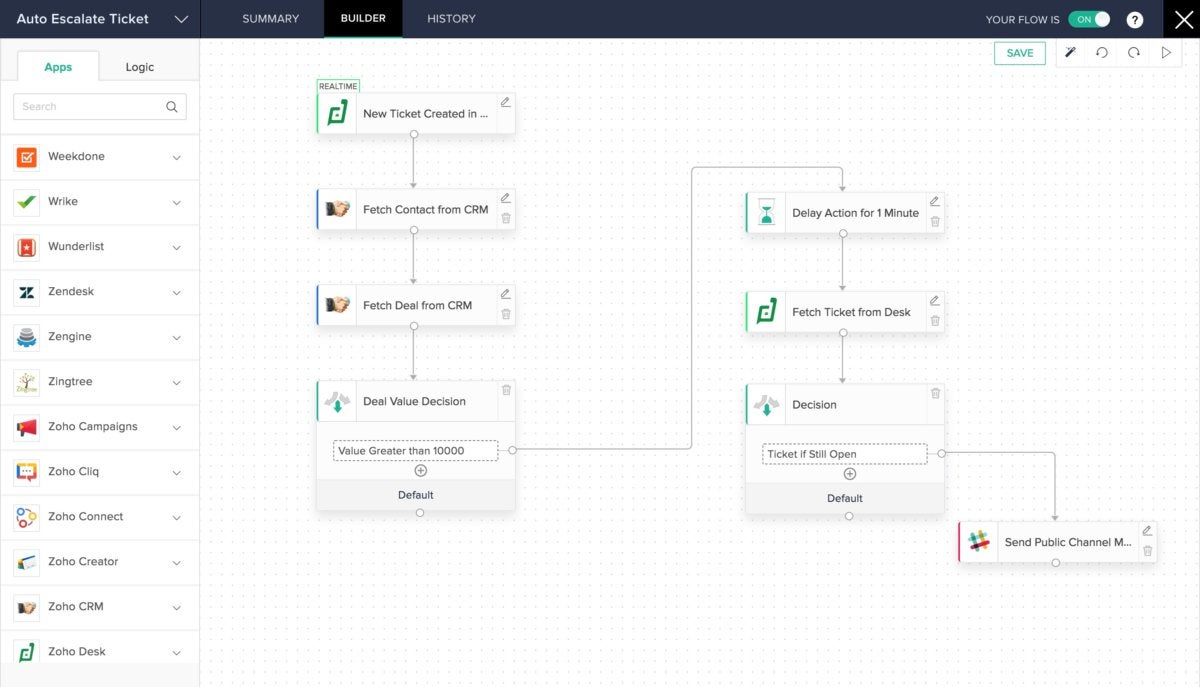 Zoho
Zoho Flow's builder tool provides a drag-and-drop interface in which workflows are created and displayed.According to Vegesna, a major differentiator for Zoho Flow is its builder tool, which provides a drag-and-drop interface in which workflows are created and displayed. Another is the ability to create custom functions.
While workflows can be simple alerts, logic functions allow more complex and detailed workflows to be set up, including time-based actions. Users can code custom functions using Zoho’s own programming language, Deluge, which is used by some 50,000 developers globally.
An example of this would be the ability to insert custom code to perform sentiment analysis on the content of a ticket – i.e. positive, natural or negative - and then add decision branches that direct it to the relevant communication channel. If the sentiment is negative, the ticket can be posted in Slack, for instance. Or if it is positive, a timed trigger could automatically escalate the ticket after a day if it is still open.
“Logic like this can be created and customized and by looking at it visually [with the builder tool] you really know what is going on with the flow,” said Vegesna.
The ability to build process flows that take sentiment into consideration for branching purposes is “a big positive” that makes Flow attractive, said Leary.
“The branching capabilities with sentiment offer something that will appeal to many people, along with a really nice UI that simplifies the flow creation process and make it more attractive for end users to try out,” he said.
“And if you're a Zoho One customer, it's even better because Flow is included, so you get to use it for no additional cost.”
Zoho Flow costs $10 per organization per month and is available for free as part of the Zoho One subscription service. -
#3031Reply in IT news
ECMAScript, the standard specification underlying JavaScript, is on track for a new release, likely in June.
So far, four proposals have been finalized for inclusion in the ECMAScript 2018 specification, said Zibi Braniecki, a senior software engineer at Mozilla who participates in the development of ECMAScript.
[ Go deeper at InfoWorld: Beyond jQuery: An expert guide to JavaScript frameworks • The complete guide to Node.js frameworks • The 10 essential JavaScript developer tools • The 6 best JavaScript IDEs and 10 best JavaScript editors. | Keep up with hot topics in programming with InfoWorld’s App Dev Report newsletter. ]
The four proposals include:Lifting of the template literal restriction, to enable the embedding of languages, including domain-specific languages (DSLs). Currently, restrictions on escape clauses make this a problem. The revision cleans up the behavior of literals, letting them be used for DSLs so programmers can create their own minilanguages if neeeded.
Adding the s (dotAll) flag for regular expressions, providing consistent behavior for these expressions. The feature is intended to address limitations in which the dot (.) in regular expressions does not match line-terminator characters, said author Axel Rauschmeyer, who has focused on JavaScript. The s flag changes that. This flag will operate on an opt-in basis, so existing regular expressions patterns will not be affected.
Async iterators, adding syntactic support for asynchronous iteration using AsyncIterable and AsyncIterator protocols. The feature makes possible a for-wait-of iteration statement while adding syntax for creating async generator functions and methods.
Rest/spread properties, providing a minor syntactic improvement.
Async iteractors enable a new class of software to be written, solving new classes of problems, Braniecki said. The capability combines two powerful features added to JavaScript in recent years: asynchronous operations and iterators/generators. Generators and iterators let code be executed lazily while asynchronous operations allow for code that does not block. Combined, these let developers write lazy code that will not block.
There are four other features under strong consideration, which would make it easier to program with JavaScript, Braniecki said. These include:Regexp (regular expression) look-behind assertions, fixing a shortcoming with lookarounds, which are zero-width assertions that match a string without consuming anything. Currently, lookaround assertions can be used in a forward direction but not a backward direction. With lookbehind assertions, developers would be able to ensure that a pattern is or is not preceded by another; for example, matching a dollar amount without capturing the dollar sign.
Regexp Unicode property escapes, giving developers a better way to access Unicode character properties. Property escapes in the form of\p{…} and \P{…} would be added.
Promise.prototype.finally, for writing cleaner code when a programmer does not does not close a socket or clean up memory. A class of errors would be removed.
Updating the function Function.prototype.toString. The toString ()method would return a string representing a function’s source code.
Braniecki expects the ECMAScript 2018 features to be implemented in browsers this year. Some already have been implemented.
Braniecki considers ECMAScript 2018 to be a fairly modest release. Next year, he anticipates bigger capabilities for ECMAScript, with conversations being held about asynchronous iterators and extending classes.
-
#3032Visual Studio gets an app for sketch-based UI prototyping The experimental Ink to Code app for WindoReply in IT news
Microsoft Garage, an outlet for experimental projects at the company, is offering an app to help Visual Studio users prototype interfaces for Universal Windows Platform (UWP) applications for Windows 10 as well as for Android apps.
Called Ink to Code, this Windows 10 app lets developers build wireframe sketches and export them to Visual Studio, making it quicker to prototype interfaces. Developers and designers can use the app for collaboration, with Ink to Code providing a canvas for brainstorming meetings and bridging the gap between collaborators with different levels of technical knowledge.
[ Review: Visual Studio 2017 is the best ever. | What’s new in Microsoft’s Visual Studio 2017. Cut to the key news and issues in cutting-edge enterprise technology with the InfoWorld Daily newsletter. ]
Sketches of basic elements are captured and translated into the early incarnations of an application. Initially, visual elements are supported such as labels, text fields and images.Ink to Code uses the Smart Ink technology built into UWP. Introduced last year in the Windows 10 Creators Update, Smart Ink uses artificial intelligence to understand a user’s writing and intent. Smart Ink was added to Windows Ink.
Where to download Ink to CodeYou can download Ink to Code for free from the Microsoft Store. It is available in the United States and Canada at the moment.
This story, "Visual Studio gets an app for sketch-based UI prototyping" was originally published by InfoWorld.
-
#3033Reply in IT news
Microsoft added a raft of new features to its Teams group chat platform this week, making it easier to interact with third-party apps and find new services through an app directory. The update, Microsoft said, is its biggest single release of new functionality since Teams launched last year.
The launch of the Teams app store means it is now possible to search and discover apps and services to integrate with the chat platform. Users can find apps by searching by name, category or integration type, such as bots. The move brings Teams in line with rival Slack, which launched its own app directory in 2015.
[ Related: 8 Microsoft Teams tips and tricks ]
A personal app view puts the most commonly accessed applications at a user’s fingertips and highlights items that have been assigned to them - whether that be Microsoft tools such as Planner or third-party applications like Jira Cloud. Also included in the view is a new app – dubbed Who – that lets users search for people within their organization by name or topic.Microsoft has also made it easier for users to control apps from within Teams and take quick actions directly from the command box, which has been moved to the top of the screen. Users can, for instance, search for information in an app, such as an image in Adobe Creative Cloud, and insert the results into a Teams conversation.
And slash commands shortcuts allow users to perform quick actions, such as setting their Teams status to ‘away’ by typing ‘/ away’ in the command box, or to quickly add a colleague to a team. Additional command functions are also in the works, Microsoft said, including the ability to create a task in a third-party project management app.Alan Lepofsky, vice president and principal analyst at Constellation Research, said the new features help bolster Microsoft’s vision of Teams “as the hub for all the Office 365 apps as well as third party integrations.
[ To comment on this story, visit Computerworld's Facebook page. ]
“No one needs ‘yet another chat app,’” he said, "but if an enterprise messaging client can provide noticeable additional value to a business process, then people will really start to adopt it.”Raul Castañón-Martínez, senior analyst at 451 Research, said the ability to work more effectively with other applications from within Teams “closes a gap” with vendors like Slack and Atlassian.
“This is something that Slack and Atlassian are particularly good at and have a gained a lead with the number of integrations they provide,” he said.
Castañón-Martínez added that Microsoft is “actually going a step further” than its competitors by providing employees with easy access to the apps their employer assigned to them and the ability to access Microsoft Graph with the Who app.
“These features can help Microsoft defend its position, given that they leverage its existing market footprint,” he said.
Microsoft clearly has big plans for Teams as the central communications tool in Office 365, effectively replacing Skype for Business over time. Although there are plans to add call control features – i.e. hold, call forwarding and voicemail – Teams currently falls short in unified communications capabilities.
“Even with the features that are coming out this year it is still not close to becoming a replacement for a phone system,” he said.
Nevertheless, as a collaboration tool, Teams is now “pretty much up to par with Slack; even ahead in some areas,” Castanon-Martinez said.
-
#3034Reply in IT news
Google Cloud and MobileIron have announced a partnership to provide a secure enterprise applications and services portal.
Why Google Cloud and MobileIron? Because Google wants to use its Orbitera commerce platform, which enables the buying and selling of software and services in the cloud – and it needs an OS- and hardware-agnostic distribution and security partner.
MobileIron will not only help Google distribute the apps through its enterprise mobility management (EMM) platform, but its software can also provide analytics that show which apps and services are the most popular, and with whom.
"When you think about cloud service, you're accessing it through applications living on devices that could be mobile or a Mac or a PC," a MobileIron spokesperson said. "And even those [desktop] operating systems are increasingly looking like mobile OSes."
The new service, expected to be available in the second half of the year, will mostly be built atop the Security Assertion Markup Language (SAML), an open standard for authenticating and authorizing data transfers between an identify provider, like MobileIron, and a service provider, such as Google.[ To comment on this story, visit Computerworld's Facebook page. ]
The first instances of the new service will likely come through a telecom operator, such as a Deutsche Telekom or AT&T, which would create a cloud services marketplace that would feel a lot like the Google Apps Store, according to the MobileIron spokesperson. An enterprise would then select an app or service and any charges for them would simply be applied to the enterprise's monthly telecom bill."Each enterprise will deploy dozens or even hundreds of cloud services and they need an easy way to buy those services, distribute them to employees, and help ensure the security of the corporate data they contain," Simon Biddiscombe, CEO of MobileIron said in a statement. "Operators have a fantastic business opportunity to become a bridge for [a] secure cloud services marketplace for their customers. Our work with Google Cloud will look at ways we can help operators sell the way they want to sell and help CIOs to buy the way they want to buy."
-
#3035Reply in IT news
Everyone’s heard of the IoT – smart thermostats, Internet-connected refrigerators, connected lightbulbs – but there’s a subset called industrial IoT that has a much more significant day-to-day impact on businesses, safety and even lives.
The term IIoT refers to the Industrial Internet of Things. In broad strokes, it’s the application of instrumentation and connected sensors and other devices to machinery and vehicles in the transport, energy and industrial sectors.
What that means in practice varies widely. One IIoT system could be as simple as a connected rat trap that texts home to say that it’s been activated, while another might be as complicated as a fully automated mass production line that tracks maintenance, productivity and even ordering and shipping information across a huge, multi-layered network.
-
#3036Reply in IT news
The Rust language is on track for several key new capabilities this year. A draft roadmap for the Mozilla-sponsored language would polish and stabilize all existing features, including impl Trait, macros 2.0, SIMD, generators, custom registries in the Cargo package manager, and nonlexical lifetimes, as well as revamp modules. And tools such as the Rust Language Server (RLS), the rustfmt code formatter, libraries, and documentation would be brought to 1.0 release status. The Rust 2018 release, aka Epoch, might also have build-system integration improvements.
Rust 2018 would likely ship in September, according Mozilla’s draft roadmap.
[ What is Rust? The way to do safe, fast, and easy software development. | Next: Learn how to get started with Rust in the InfoWorld tutorial. | Keep up with hot topics in programming with InfoWorld’s App Dev Report newsletter. ]
Because the intent is to have only stable features in Rust 2018, Mozilla may deliver other new capabilities separately from Rust 2018. Such “unstale” features could include outside Aconst generics, generic associated types, and specialization, permitting multiple impl blocks to apply to the same trait as long as one of the blocks is more specific than the other.Mozilla’s work this year on the Rust compiler is set complete language features and make improvements to compile times and error messages. Building the rustfix tool, to read and apply messages from rustc and third-party lint tools, is also a goal. Rust’s library ecosystem, meanwhile, would get investments in quality, discoverability, and domain-specific content.
-
#3037Reply in IT news
Microsoft last week gave Windows 10 testers a peek at an app that shows exactly what diagnostic data the company collects from customers and transmits to its own servers.
The issue of Windows 10's telemetry has dogged the operating system since its debut, with critics taking Microsoft to task for over-zealously harvesting information, for refusing to describe what data it collects, and for preventing customers from opting out.
[ Further reading: How to choose the right Windows 10 release channel ]
With the release of Windows Insider build 17083 on Jan. 24, Microsoft addressed the criticism about transparency by putting an app, named "Diagnostic Data Viewer," into the hands of beta participants."The Diagnostic Data Viewer is a Windows app that lets you review the diagnostic data your device is sending to Microsoft, grouping the info into simple categories based on how it's used by Microsoft," wrote Dona Sarkar, a software engineer in the company's Windows and Devices group, and the spokeswoman for the Insiders program. Although currently available only to Insiders, the viewer is scheduled to appear in the next Windows 10 feature upgrade, set to launch in March or perhaps early April, and likely identified in Microsoft's yymm format as 1803.
The Diagnostic Data Viewer could be downloaded from the Microsoft Store, the authorized source of Universal Windows Platform (UWP) apps. Only those running Windows 10 build 17083 or later were able to successfully install the app.According to Sarkar, the viewer shows "the exact data uploaded to Microsoft" and lets users search for specific diagnostic events as well as filter the events for one or more broad categories, such as "Product and Service Usage" or "Software Setup and Inventory." In the brief documentation on the app, Microsoft recommends that users turn off the viewer when they're done examining the data, as the act of collection can consume up to 1GB of storage space on the device.
[ To comment on this story, visit Computerworld's Facebook page. ]
Microsoft's introduction of the Diagnostic Data Viewer was an expansion of the April 2017 move that revealed more about what information Windows 10 collects. Before that, in January 2017, Microsoft made minor concessions, saying it would reduce what was collected when users selected the "Basic" setting.But it's highly unlikely that the new app signals Microsoft will yield to its customer critics, said Michael Cherry, an analyst at Directions on Microsoft. Instead, Cherry argued, it was probably prompted by the company's continued discussions with European Union (EU) member states' officials about the impending General Data Protection Regulation (GDPR), which goes into force in May.
Under GDPR, companies must obtain explicit consent from their customers for any use of personalized information, Cherry added. "You have to give full and complete disclosure of what you're collecting, and how long you're collecting it for," he said. "And people have to opt in. That's still not a part of Windows 10."
Microsoft's motivation can be traced to GDPR and its demands, Cherry went on. "There has been no market resistance [to Windows 10's data collection] or legislation here about it, so it's reasonable to conclude that it's due to the GDPR. But whether it's sufficient will be up to them [the EU member states' data protection agencies]."
Cherry expects Microsoft to fiercely defend its telemetry practices, even as the company makes incremental concessions on secondary fronts, because the data is crucial to how Microsoft now services Windows. "Because so many people are relying on Windows Defender as their antivirus, [Microsoft] needs a certain amount of telemetry to keep that and security updates working," Cherry said. "They need to know that the latest antivirus signature has been applied. [And on security updates] they need to know how many people have applied a patch."
January's news that most processors contained vulnerabilities - identified using the nicknames "Meltdown" and "Spectre" - was a perfect example. Last weekend, after Intel had warned customers, including end users, to stop deploying firmware updates for one of the Spectre flaws, Microsoft followed suit, and issued an emergency update that disabled a previous patch for the same Spectre bug. Microsoft would be very interested in knowing how many systems had had that out-of-band patch applied to them, and diagnostic data would show the company exactly that.
"They would want to know how big the [Spectre patch] exposure was," Cherry said.
Telemetry also plays a critical part in how Microsoft rolls out each Windows 10 feature update, the twice-annual refresh that adds new functionality and may change the operating system's user interface (UI) and/or user experience (UX). "They also need telemetry for the new release cadence. We know they throttle the releases," said Cherry, referring to the practice of initially issuing an update to a small number of devices, usually those equipped with the latest drivers.
Microsoft uses diagnostic data to identify problems; it then makes fixes and expands the pool of potential recipients. "They take a long time before [a release] goes out to every machine," Cherry pointed out.
That said, Cherry praised Microsoft for pulling back more of the curtain with the Data Diagnostic Viewer. "It does change the telemetry debate," Cherry said. "Before, we were totally blind about what was collected. So, this is a step in the right direction.
"But while I feel Microsoft is moving in the right direction, it's still insufficient," Cherry asserted. Microsoft may be revealing more about diagnostic data collecting, but it does so grudgingly. "It's not quite one step forward and two steps back, but it's not a full step forward either," he said."I don't deny that collecting information about how the operating system fails doesn't lead to improvements in the OS," said Cherry. "I understand why they collect data. But why do they have to collect so much?"
And that's not something the Diagnostic Data Viewer can explain.
This story, "Windows 10 shows users what data it collects and phones in" was originally published by Computerworld.
-
#3038Reply in IT news
This powerful micro-cut shredder from AmazonBasics turns a letter-sized sheet into 2,235 pieces of confetti, up to 6 sheets at a time (5/32 by 15/32 inches; security level P-4). Inserted one at a time, it also destroys credit cards, rendering them completely unusable. It features a generous 4.1-gallon waste bin that is easy to manage. This micro-cut shredder averages 4.5 out of 5 stars on Amazon from over 1,900 people (72% rate a full 5 stars: read reviews). Its typical list price of $50 has been reduced 29% to $36. See it on Amazon.
This story, "Get 29% Off This 6-Sheet Micro-Cut Paper and Credit Card Shredder" was originally published by TechConnect.
-
#3039Reply in IT news
When you find a good cable for a cheap price, it never hurts to grab it. Anker's USB-C to USB cables feature a double-braided nylon exterior, toughened aramid fiber core and laser-welded connectors, which Anker says makes them more reliable and longer lasting. With this deal, you'll get two 6-foot cables for $9.49, which is a healthy discount from its average list price. See Anker's discounted cables now on Amazon, where they currently average 4.5 out of 5 stars from over 300 customers.
-
#3040Reply in IT news
When you find a good cable for a cheap price, it never hurts to grab it. Anker's USB-C to USB cables feature a double-braided nylon exterior, toughened aramid fiber core and laser-welded connectors, which Anker says makes them more reliable and longer lasting. With this deal, you'll get two 6-foot cables for $9.49, which is a healthy discount from its average list price. See Anker's discounted cables now on Amazon, where they currently average 4.5 out of 5 stars from over 300 customers.


