Back to aLinDev's profile
aLinDev

Posts by aLinDev

4,385 posts

  1. #4061
    Reply in IT news


    If you're a tax time do-it-yourselfer, this is a deal that will save you money, and potentially make you some money as well.


    H&R Block's popular tax software is fully updated for 2018 and designed to make your 2017 tax prep easier and more convenient. Step-by-step interviews guide you through a customized experience relevant to your tax situation, so you know everything is accounted for. This version contains everything you need to prepare your federal and state taxes in one complete program, and everything can be handled electronically (including the PC or Mac software download). Right now the tax software's price is reduced 25% on Amazon to $33.74.


    You'll notice a "5% refund bonus offer" included with this purchase. In 2018, if you purchase an Amazon gift card with some/all of your federal tax refund, H&R Block will add 5% as a bonus ($5,000 bonus limit per customer). I'm not great with math, but this does appear to be free money for those expecting a Federal refund.  See the popular tax software now on Amazon.


    Our new gaming site is live! Gamestar covers games, gaming gadgets and gear. Subscribe to our newsletter and we’ll email our best stuff right to your inbox. Learn more here.

    This story, "Get 25% Off H&R Block's Federal & State Tax Software, Plus a 5% Amazon Bonus" was originally published by TechConnect.

  2. #4062
    Reply in IT news


    This powerful micro-cut shredder from AmazonBasics turns a letter-sized sheet into 2,235 pieces of confetti, up to 6 sheets at a time (5/32 by 15/32 inches; security level P-4). Inserted one at a time, it also destroys credit cards, rendering them completely unusable. It features a generous 4.1-gallon waste bin that is easy to manage. This micro-cut shredder averages 4.5 out of 5 stars on Amazon from over 1,900 people (72% rate a full 5 stars: read reviews). Its typical list price of $50 has been reduced 29% to $36. See it on Amazon.

    This story, "Get 29% Off This 6-Sheet Micro-Cut Paper and Credit Card Shredder" was originally published by TechConnect.

  3. #4063
    Reply in IT news


    When you find a good cable for a cheap price, it never hurts to grab it. Anker's USB-C to USB cables feature a double-braided nylon exterior, toughened aramid fiber core and laser-welded connectors, which Anker says makes them more reliable and longer lasting.  With this deal, you'll get two 6-foot cables for $9.49, which is a healthy discount from its average list price. See Anker's discounted cables now on Amazon, where they currently average 4.5 out of 5 stars from over 300 customers.

    This story, "Get 2 USB-C to USB 6-foot Cables For $9.49 Right Now On Amazon" was originally published by PCWorld.

  4. #4064
    Reply in IT news


    displaying weather forecasts, news updates, sports scores, song lyrics and much more. All you need to do is ask Alexa. It fits comfortably on a nightstand and works well as an alarm clock and bedside calendar as well. Watch videos, call your friends, control your smarthome -- new features are added all the time. Right now, if you buy two, Amazon will activate a $40 discount in your cart. See this deal now on Amazon.

    This story, "Amazon Is Offering a $40-Off Deal On Its Echo Spot Devices" was originally published by PCWorld.

  5. #4065
    Reply in IT news

    If capacity and portability are your primary concerns, and the Backup Plus Portable fits up to 5TB in pretty much a standard 2.5-inch USB external package. It's fast with large files, but on the slow side with small ones. Regardless, it's a worthy drive that gives you more space for your movies and games.

    Our runner-up for this popular category is Seagate’s slightly larger and somewhat faster Backup Plus Portable. Like the WD above, it’s a USB 3.1 Gen 1 (5Gbps) drive. It tops out at 5TB in a single drive and can also be had in 1TB, 2TB, and 4TB capacities. There’s even a “fast” 4TB version that uses two hard drives in RAID for more performance.

    In our tests of the 4TB version, we found the Seagate to be slightly faster with large file transfers (think movies) but worse with small file transfers (think Office documents). It’s still a worthy runner-up, though. (Read our full review.)

    Best external performance drive


    T5 SSD


    Read PCWorld's review

    $349.99MSRP $399.99

    VIEW

    on Amazon

    The T5 is easily the fastest non-RAID portable USB SSD we've tested. It makes full use of its Gen 2, 3.1 interface while retaining the svelte profile of the T3. A winner for sure.

    Remember that scene in Office Space where Peter Gibbons is desperately trying to save files to disk before getting out of the office? Yeah, mmkay. If you need ultra-fast performance in a package that you can put in your pocket, look no further than Samsung’s new T5 . Not much larger than a book of matches, the T5 comes in sizes from 500GB to 2TB. The best part is its speed. The drive features a USB 3.1 Gen 2 (10Gbps) over USB Type C.

     
    And no, unlike most USB “thumb drives” this baby doesn’t hit the wall when writing files. It can write 20GB of files in just 110 seconds. If it’s a single large file, it’ll write it in 58 seconds. (Read our full review.)

    The only drive we’ve seen that’s faster is SanDisk’s Extreme 900, but that drive uses two SSDs in RAID to hit that performance. It’s also more like a coat-pocket size than a jeans-pocket size. We think the portability of the Samsung T5 is enough to move it into the top spot. 

  6. #4066
    Reply in IT news

    Anyone who uses a PC should have an external drive. It’s not only a useful means of data backup and storage, it also allows you to transport files from your desktop or laptop to another device.

    External drive cheat sheet

    Our quick-hit recommendations:

    Xbox One X one users, as well, would be wise to invest in an external drive as a way of augmenting the console’s measly 1TB hard drive (the external drive needs to be USB 3.0-compatible and will be formatted when you insert the drive). 

    The question is, which external drive is right for you? To answer that, we’ve combed through our reviews of both external hard disks and SSDs to pick the top drives we’ve tested. We’ll also walk you through what you need to know to buy the best external drive for your needs.

  7. #4067
    Reply in IT news

    Ring built a better mousetrap and quickly became the king of video doorbells. Lots of competitors followed, but few have a truly better doorbell. Ring wasn’t the first to integrate a video camera into an outdoor light—Netatmo introduced one in late 2016, and Kuna had one earlier than that—but if you own one of Ring’s doorbells, you like it well enough to pay for a subscription, and you want to surveil more of your yard, you should add one of Ring’s other outdoor products. The Ring Floodlight Cam will make an excellent replacement for any existing floodlight.

    If you haven’t committed to the Ring ecosystem, you’ll want to explore your options before buying this product. That subscription I mentioned is the biggest reason why. While Ring emphasizes that subscriptions are optional, you’ll be restricted to real-time viewing of what the camera sees if you don’t opt in to one after your 30-day free trial. You’ll receive alerts when the camera detects motion, but you won’t be able to see the video that triggered the alert. All the other features (which I’ll get into in a moment), will work, but you won’t be able to download the video clips, either. If there’s a break-in, you won’t be able to provide the police with any forensic evidence the camera might have captured of the perpetrator.

    MENTIONED IN THIS ARTICLE

    Ring Spotlight Cam


    Read TechHive's review

    $199.00MSRP $199.00

    VIEW

    on Amazon

    Ring offers two subscription plans, both of which include cloud storage and video review with sharing (you can view recorded clips, download them, and share them on social media directly from the app). The Ring Protect Basic plan costs $3 per month ($30 if paid annually) per camera. The Ring Protect Plus plan costs $10 per month ($100 if paid annually). It covers an unlimited number of cameras and extends the warranty from one year to the life of the product (and includes both damage and theft protection, so that if the camera breaks or someone has the temerity to steal it, Ring will replace it. Ring’s FAQ also mentions 24/7 professional monitoring, but that’s for the upcoming Ring Alarm.

    [ Check out Amazon's CES Showcase, happening right now, for great deals on everything from home automation products to PC's. ]Ring
    Video quality is easily one of the Ring Floodlight Cam's best features. 

    Subscriptions: Get used to ‘em

    MENTIONED IN THIS ARTICLE

    Maximus Camera Floodlight


    Read TechHive's review

    $249.00MSRP $249.00

    VIEW

    on Kuna

    Subscription plans are becoming the norm with home security cameras, with Netatmo being an outlier. Its Presence camera has onboard storage in the form of a 16GB microSD memory card, and you can download recorded video to your smartphone via the app. It has no cloud storage option unless you link the app to your Dropbox account. Netgear’s indoor/outdoor Arlo Pro 2 is also unusually generous, providing seven days of storage for up to five cameras. The Maximus Camera Floodlight that I reviewed in earlier in 2018, which is based on Kuna’s technology, allows you to look back in time two hours and download up to three videos per month without a subscription. Its least-expensive plan costs $5 per month for one camera and provides a seven-day history with unlimited downloads. Costlier plans increase the number of cameras covered and extend the time you can look back at recorded events.

     Ring
    Ring provides excellent installation instructions even if its mounting mechanism is somewhat primitive. (This example shows a surface-mounted junction box, which won't be typical if you're replacing an existing fixture.)

    We previously reviewed the Ring Spotlight Cam, which is designed to be plugged into an outdoor outlet and has a single LED light. This review is of the Ring Floodlight Cam, which must be hardwired to your electrical wiring and is outfitted with two LED lights. Like the aforementioned Netatmo and Kuna products, most people will install the Floodlight Cam as a replacement for an existing outdoor light. That’s a whole lot easier than cutting a hole in your exterior wall, installing a junction box, and running Romex to it. Most people would want to hire an electrician to do all that. It’s relatively easy to replace an existing outdoor fixture, and Ring makes it even easier with excellent instructions and videos covering every step of the process that you can watch on your phone. They even provide a handy multi-tool.

    As easy as the Floodlight Cam was to install, however, I prefer the elegant locking-ring mechanism that Maximus came up with. Ring’s device simply mounts to a pair of threaded screws that emerge from a brace attached to the junction box: You push these through two holes in the assembly’s chassis and then anchor it down with a pair of plastic-covered nuts.

    Ring
    The Ring Floodlight Cam's industrial design is just that—industrial.

    Ring Floodlight Cam feature set

    The Floodlight Cam has two LED floodlights mounted on articulated arms that can be moved independently of each other. Thes lights are rated to produce a combined 3,000 lumens of brightness, but to my eye, the dual floodlights on the Maximus covered more area. This could be due to the cone-shaped shades on the Ring product that focus the beams more tightly than the flat LED panels on the Maximus, which are rated to produce 2,400 lumens. And unlike that device, you can’t dim the Floodlight Cam’s brightness.

    A box containing the camera is mounted below and between the floodlights, with a dome-shaped motion sensor emerging from the bottom of that. The camera, which has a 140-degree field of view—slightly narrower than the 155-degree field of view on the Maximus—captures video in 1080p resolution. There’s a microphone and a speaker onboard, so you can have two-way conversations with people on the other side of the connection. There are no pre-recorded messages that play in response to motion, and the camera itself doesn’t make any sounds that would draw an intruder to present their face to the camera when they set off the motion sensor. Those are features that I really like about the Maximus. Ring rates its product IPX5, which means it’s not rated for dust incursion, but it is protected from water sprayed from up to a 6.3mm nozzle.

     
    The Floodlight Cam’s motion sensor detects movement over a 270-degree radius and can be fine-tuned to reduce or increase its sensitivity (you can, for example, set it to respond only to humans and ignore cars or four-legged visitors). You can also schedule the motion sensor so that it’s active only on certain days and/or within defined time windows. The Ring app provides an excellent tool for creating multiple irregularly shaped motion zones, so that you can prevent objects such as shrubs and trees from triggering the lights and camera. You can also fine-tune the area in which motion will trigger the lights to turn on.  And if you don’t want the lights to come, for whatever reason, the camera has very good night vision (a feature the Maximus lacks).

    Ring
    The ability to plot more than one motion zone makes it easy to prevent windblown trees and shrubs from triggering false alerts. 

    Audio and video quality

    The Ring Floodlight Cam records video with excellent quality, with just a little barrel distortion at the extremes of its field of view. The camera connects only via Wi-Fi, which can be a problem if you’re mounting it far from your home’s nearest access point. I didn’t find this to be a problem with the Linksys Velop mesh Wi-Fi system I use, since one of its mesh points is in a room close to the garage where I mounted the camera. It can connect only to 2.4GHz networks, which can be crowded with legacy devices and are more susceptible to interference than 5GHz networks. Ring attributes this limitation to the 2.4GHz frequency band’s superior range, but the fact that it’s equipped with an 802.11n adapter tells me the choice has more to do with bottom-line cost. The 802.11ac routers I’ve tested deliver excellent range on the 5GHz band, and you’ll find several outdoor cameras that operate on both bands, including the Maximus Camera Floodlight and the Nest Cam Outdoor and Nest Cam IQ Outdoor (neither of the Nest Cams have lights attached to them, though).

    Ring
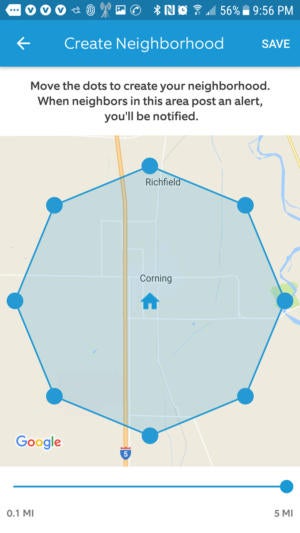
    Ring Neighborhoods lets you share video clips of suspicious activities with neighbors within a five-mile radius of your location (you can also draw the circle much tighter or in any abstract pattern).

    As with all products that upload video to the cloud, however, you’ll want broadband service with relatively fast uplink service. That’s something I can’t get in my rural location (the best I can buy is about 1Mbps up and 16Mbps down). As a result, it takes a bit of time to establish a connection to the camera’s live feed, and audio was choppy at best. You can also stream the camera’s live feed (audio and video) to an Amazon Echo Show or Echo Spot, but that’s dependent on having fast upload speed, too, so it takes several seconds for my Echo Show to establish a connection. Those aren’t Ring’s problems, of course, and the Maximus can’t stream to a display-equipped Echo at all, although the company tells me that’s in the works. On the other hand, you can use an Echo to turn the Maximus’s floodlight on and off, and you can’t do that with the Ring Floodlight Cam.

    While you’re viewing the camera’s feed on your smartphone, you can push buttons to listen to the ambient sound, initiate a conversation with the person on the other side of the camera, turn the floodlights on and off, and sound an extremely loud—110dB—siren. You can share video clips with neighbors using Ring Neighborhoods, a high-tech video-based neighborhood watch system that can alert people to suspicious activity near their homes. This feature can be customized to cover as little or as much territory—up to a five-mile radius—as you’d like.

    Should you buy a Ring Floodlight Cam?

    The answer to that question is an easy “yes,” if you’ve already invested in other Ring products. You don’t want to deal with different apps with different user interfaces—and different subscription plans—to keep an eye on different areas of your property. The Ring Protect Plus plan covers an unlimited number of cameras, so you could put one of Ring’s doorbells at your front door and its Floodlight or Spotlight cams at every other door and anywhere else you have electrical power (or not, since some of its Spotlight cams run on battery power, and with optional solar-power recharging).

    Ring
    Click the onscreen icons for two-way communication, to turn the floodlight on or off, sound the 110db siren, or share a clip with your Ring Neighborhood.

    The buy-it/skip-it decision is harder if you’re not already vested in the Ring ecosystem. But here’s a conundrum for homeowners: Ring doesn’t currently offer any indoor cameras (neither does Maximus). Netatmo does, but its indoor camera is relatively weak (and its Presence costs $50 more than either the Ring Floodlight Cam or the Maximus Camera Floodlight). Nest has indoor cameras, too, but it doesn’t have any outdoor cameras with integrated lights (although it has strong hooks into smart home systems that would enable you to tie its cameras into smart lights or light switches).

    If you don’t already own a Ring product, and don’t anticipate wanting the company’s upcoming home security system, Ring Alarm, I think the Maximus Camera Floodlight is the better choice. You’ll use voice commands to control lights far more often than you’ll call up a video feed on a smart speaker’s display. And while both floodlight cameras have optional subscription plans that aren’t all that optional in reality, the Maximus camera is at much more useful without a subscription.

    This story, "Ring Floodlight Cam review: An excellent choice—if you’re living in Ring’s ecosystem" was originally published by TechHive.

  8. #4068
    Reply in IT news

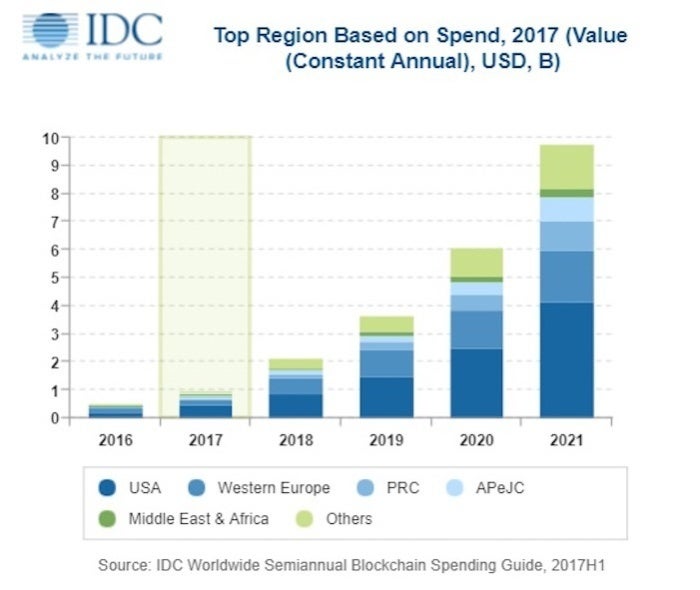
    Spending by enterprises and other entities on blockchain networks is expected to reach $2.1 billion this year, more than double what was spent on the distributed electronic ledger technology in 2017.

    The U.S. will lead the world in blockchain investments, accounting for 40% of spending, followed by Western Europe, China and the Asia Pacific region (not including Japan), according to a new report from IDC.

    By 2021, spending on blockchain is expected to reach $9.2 billion, the report said.

    IDC
    Last year was considered a year of experimentations for the still-evolving technology, when businesses came to see both its benefits and the challenges it still must overcome, according to IDC.

     [ Related: Befuddled by blockchain? What to consider before diving in ]
    That means 2018 a crucial year for enterprises as they move from proof-of-concept projects to full blockchain deployments, according to Stacey Soohoo, IDC's research manager for Customer Insights & Analysis.

    The industries expected to see the fastest growth in blockchain spending will be professional services, discrete manufacturing, and the resource industries. All are likely to show a better than 83% combined annual growth rate.

    Financial services leads the way

    Driven by banking industry adoption, financial services is expected to lead spending in the U.S. with $754 million this year.

    Other industries, such as distribution and the services market, are expected to spend $510 million, with manufacturing and the resources sector spending as much as $410 million this year.

     
    IT services and business services will account for about 75% of all blockchain spending throughout the year fairly. Blockchain platform software will be the largest category of spending outside of the services category and one of the fastest growing categories overall, along with security software.

    "The U.S. will look to improve efficiencies in existing operations while promoting new applications in others, creating new streams of revenue and areas of spend," Soohoo said in a statement. "With increased investments driven by pressures to keep up with the accelerating pace in innovation, the world will continue to look to the U.S. for guidance as other regions forge ahead in their own blockchain projects and initiatives."

    Blockchain lends itself to a number of common use cases in the financial services market, including regulatory compliance, cross-border payments & settlements, custody and asset tracking, and trade finance and post-trade/transaction settlements, according to IDC.

    In the distribution and services sector and the manufacturing and resources sectors, the leading use cases include asset and goods management and lot lineage and provenance.

    Cross-border payments & settlements will see the largest spending in 2018 ($242 million), followed by lot/lineage provenance ($202 million) and trade finance & post-trade/transaction settlements ($199 million). These three use cases will remain the largest in terms of overall spending in 2021 as well, according to the report.

    "There are a multitude of potential new use cases for blockchain, as transactions and records are the lifeblood of just about every organization," said Jessica Goepfert, IDC's program director for Customer Insights and Analysis. "However, we are seeing initial blockchain spending [designed] to transform existing highly manual and inefficient processes such as cross-border payments, provenance and post transaction settlements. These are areas of existing pain for many firms, and thus blockchain presents an attractive value proposition."

    Trust in the digitial economy is key

    Over the next two years, enterprises are expected to ramp up efforts to test blockchain technology as part of a new method of establishing trust in a digital economy, according to a recent report from Deloitte LLP.

    "This is very real and something we're aggressively excited about," said Brigid McDermott, vice president of Blockchain Business Development at IBM. "What blockchain does is provide a trust system of record between disparate companies."

     
    For example, IBM and Maersk this month announced a joint venture to deploy a blockchain-based electronic shipping system that will digitize supply chains and track international cargo in real time for all parties involved. If it receives regulatory approval, the companies expect the shipping platform to be live in three to six months.

     Maersk
    A new blockchain-based, distributed electronic ledger could save the shipping industry billions of dollars a year by replacing the current EDI and paper-based system for tracking cargo and attaining approval from customs and port authorities.

    Volatility ahead?

    One problem that may affect blockchain is its crowdfunding component –  cryptocurrencies such as bitcoin and initial coin offerings (ICOs).

    ICOs are a method of funding blockchain projects through the sale of virtual digital currency, such as Ethereum's Ether. Cryptocurrencies lack traditional backing, like that of fiat-based currencies created by governments, and initial public offerings (IPOs) that most often have some form of corporate equity behind them.

    A lack of fundamental valuation and the due diligence process by potential investors is leading to extreme volatility in the initial coin offering (ICO) market, according to new research published by Ernst & Young (EY).

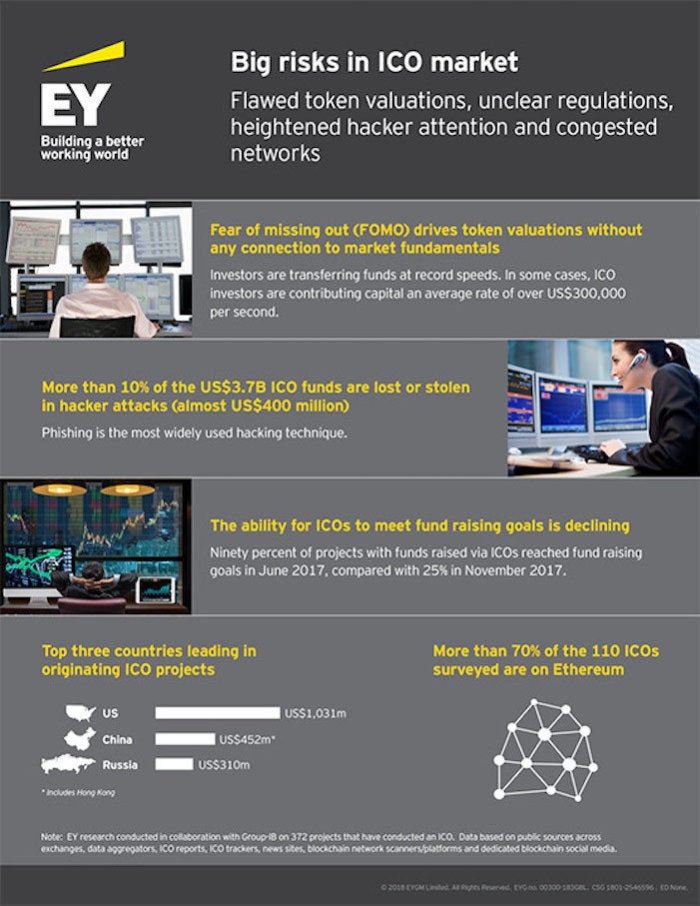
    The research also found that in some cases ICO investors are contributing capital at an average rate of over $300,000 per second.

    EY studied 372 ICOs around the world, and discovered they raised $3.7 billion in funds, twice the volume of venture capital investments in blockchain projects.

    The U.S. is leading the ICO race, accounting for more than $1 billion in 2017. Russia and China followed with $300 million in ICOs each.

    "As ICOs continue to gain popularity and leading players emerge globally, there is a risk of having the market swamped with quantity over quality of investments," said Paul Brody, EY Global Innovation Blockchain Leader. "These high-risk investments and the complexity of ICOs need to be managed to ensure their credibility as a means of raising capital for companies, entrepreneurs and investors alike."

    EY found there may be no business need for many of the utility tokens, which are essentially a form of application-specific currency that blend the technology features of blockchains with a speculative component for investors where the tokens' value will rise as usage increases, according to EY.

    "In fact, most ICO white papers lack a clear explanation of the business reasons for blockchain and token currency," EY said. "In most cases, there is no need for an application-specific exchange token. The core technologies and benefits of blockchain technologies can be applied to business operations without having to use proprietary digital currencies."

    Security concerns and government oversight

    ICO investors also face other risks: theft from hacking and increased regulatory oversight, according to EY.

    For example, cryptocurrencies have begun to exit once-friendly China for more open nations even as other regions and businesses begin to impose restrictions on how – or even whether – they can be used.

    Ersnt & Young
    Open blockchains, such as bitcoin, are only the first to be affected by more stringent regulatory oversight. Depending on how they're used, permissioned blockchains –  those that are centrally administered and used for general transactions – could also be affected by the push to reign in the cryptocurrency technology.

    There are various "good" reasons China and other countries hope to take a more hands-on regulatory approach to cryptocurrencies, which to date have existed in an oversight Wild West, according to Martha Bennett, a principal analyst at Forrester Research.

    There are several regulatory aspects to consider, including oversight of cryptocurrencies and ICOs, "which are increasingly drawing the attention of regulators," Bennett said. "That’s a good sign; while it’ll have a deflationary [effect], it’s also needed for investor protection and to avoid systemic risk."

    There is a growing concern that cryptocurrency could be a threat to the current financial system through unbridled speculation and unsecured borrowing by consumers looking to purchase the virtual money.

    "We have seen increasing evidence that people are borrowing to invest in cryptocurrencies, and in some cases borrowing on credit cards to invest in it," Bennett said. "That could lead to a credit collapse."

    Theft from hacking has also been an ongoing problem.

    More than 10% of ICO funds are lost or stolen in hacker attacks, which amount to about $400 million, according to EY's study.

    "Hackers benefit from the hype, irreversibility of blockchain-based transactions and basic coding errors that, had the ICO been carefully reviewed by experienced developers and cybersecurity analysts, could have been avoided," the report said.

    The price of the leading cryptocurrency, bitcoin, has skyrocketed to nearly $20,000 in recent weeks only to plunge to under $10,000 before recovering to $11,000 today.

    The second most popular cryptocurrency, Ethereum's Ether, also saw its price jump over the past month from $481 to more than $1,300. It's currently at $1,059.

    Ripple, a blockchain-based financial settlement and currency exchange system, also has its own form of cryptocurrency: XRP, which banks on the network can chose to use as an intermediary between cross border currencies or not. Because of the recent investment fervor around virtual currencies, XRP's market price has also risen dramatically.

    The second area that could see additional regulatory scrutiny is the use of permissioned blockchains by regulated industries like banks, Bennett said. "Depending on the process which is being moved to a blockchain, one or more regulators may need to give their approval first. There may even be circumstances where existing regulation needs to be updated," she said.

    Permissioned blockchains, however, don’t need tokens or cryptocurrencies to function, and some have been specifically engineered without them (e.g. Hyperledger), so the crowdfunding principle is also unlikely to be of great relevance in an enterprise context, according to Bennett.

    Should there be a crash in cryptocurrency value, it would only effect blockchain projects that have raised funds with tokens "or whose business model in some [way] involves a cryptocurrency," Bennett said. "Enterprise permissioned blockchains may use a token, but the value of that doesn’t have to be related to a public cryptocurrency."

  9. #4069
    Reply in IT news

    Intel chief executive Brian Krzanich told investors Thursday afternoon that the company plans to release silicon with built-in mitigations to the Spectre and Meltdown vulnerabiities later this year, a statement that raises more questions than it answers.

    For Intel, it really has been a Tale of Two Cities scenario: Intel reported the best quarter in its history, as fourth-quarter 2017 revenue grew 4 percent year-over-year to $17.1 billion. But Intel has also been the face of Spectre and Meltdown, two critical vulnerabilities built into basically every processor it ships into the PC and server markets.

    Why this matters: Intel has been busy working with PC makers and OS vendors like Microsoft to release microcode that includes so-called mitigations, microcode updates that patch the vulnerabilities. But even that hasn’t gone so well:  Intel advised end users to stop applying patches after systems unexpectedly rebooted. Now, Intel has revealed it’s working on a more permanent fix, but the impact on users remains unknown.

    Our new gaming site is live! Gamestar covers games, gaming gadgets and gear. Subscribe to our newsletter and we’ll email our best stuff right to your inbox. Learn more here.
    'Security is a top priority'

    “Security is a top priority for Intel, foundational to our products, and it’s critical to the expanse of our data-centric strategy” Krzanich told investors in a conference call. “Our near-term focus is on delivering high-quality mitigations to protect our customers’ infrastructure from these exploits. We’re working to create silicon-based changes to future products, that will directly address the Spectre and Meltdown threats in hardware. And those products will begin appearing later this year.”

     
    Intel’s Client Computing Group reported a sales decline of 2 percent to $9 billion. Notebook revenue was flat, while sales into desktop PCs declined by 8 percent.

    Intel
    Intel’s Client Computing Group did fairly well in a tough PC market.

    Krzanich reiterated that the vulnerabilities won’t have an effect on future sales. “I can tell you, at the highest level, that we’re not seeing much of a change in those forecasts as a result of this,” he said of the discovery of the vulnerabilities and their mitigations.

    “I’ve assigned some of the very best minds at Intel to work through this,” Krzanich added. 

    6 questions Intel needs to answer

    The Wall Street analyst community had several chances to pin down Krzanich on Intel’s silicon security strategy. Instead, they peppered Krzanich with questions about the company’s proposed capital expenditures and memory plans.

     
    Important questions about the silicon fix remain hanging for end users and corporate customers. Here's what we wished the analysts had asked, and our best guesses as to the answers.

    1. When exactly will the silicon fixes take place?

    Our guess: the end of 2018. Based upon leaked product roadmaps, that would probably mean the reported “Cascade Lake-X” 14-nm parts, as well as possibly the 10-nm “Cannon Lake” parts due sometime thereafter.

    Note that Pat Moorhead, a corporate fellow at AMD and now the principal analyst at Moor Insights, disagrees. “I believe these mitigations are already built in or we would see a year delay in new chips,” he said in a message. So it’s possible that chips releasing sooner, such as Coffee Lake-S, might include these fixes.

    2. Will these fixes solve both Spectre and Meltdown vulnerabilities?

    Our guess: Just Meltdown. As our Spectre and Meltdown FAQ explains, Meltdown most strongly affects Intel processors because of the aggressive way those chips handle speculative execution. Spectre appears to require a more fundamental redesign.

    3. Will the mitigations apply only to new products, or older chips, too? 

    Our guess: only new PC microprocessors, though potentially Intel could re-spin existing processors, especially for cloud servers. Doing so, however, would open up the possibility of an actual recall, something that Intel doesn’t seem to be indicating as part of its “everything-is-fine” guidance. To reassure customers, some chips might carry a suffix to assure buyers that the mitigations are built in.

    4. What effect will those mitigations have on the chip itself?

    Our guess: Any time you add logic to a CPU, and physically increase its size, the cost is affected as well. But whether Intel would have to add dedicated logic blocks, or simply restructure the chip, isn’t known. If there were additional costs that raised prices, Intel would eat it.

    5. How will performance be affected?

    Our guess: The only guidance we have is what our tests have shown: little effect in CPU-dependent benchmarks, but more significant slowdowns in broader tests of system performance. 

    6. Will silicon with built-in mitigations boost PC sales? 

    Our guess: In consumer PCs, probably not. In enterprises, it’s more likely to be seen as a selling point. Businesses won’t want to risk exposing themselves to lawsuits, and any smart PC salesperson will remind them of this. Consumers will just grit their teeth and bear the slowdown and the lack of available GPUs.

     
    “I think we could see some increased demand for servers, but not for PCs, as I do not think many will notice the performance degradation,” Moorhead said.

    Again, our guesses are just that. Let's hope that Intel starts laying out plans for solving Spectre and Meltdown in silicon, and does it soon.

    This story, "Intel's plan to fix Meltdown in silicon raises more questions than answers" was originally published by PCWorld.

  10. #4070
    Reply in IT news

    The end of net neutrality might mean third-party browser tracking, the deprivatization of online transactions, spyware on your phone, and more. At least that’s what Dr. Kenneth Williams claims.

    Williams is director of the American Public University System (APUS) Center for Cyber Defense. When asked how net neutrality’s end could cause all this doom and gloom, the explanation requires a few steps: “When net neutrality ends, [antimalware software] providers are now at a higher cost to service providers,” he begins. This, in turn, could raise the cost of internet access for users who want to maintain the data safeguards their internet service provider (ISP) used before.

    “The cost is going to go up if you choose those, but if you’re a user that [doesn’t] care to pay the fee,” Williams continues. “Either you pay or you just go without. When you go without, there’s a risk not only to you but anyone who connects to you and sends an email to you because the virus [would be] going around all over.”

    Our new gaming site is live! Gamestar covers games, gaming gadgets and gear. Subscribe to our newsletter and we’ll email our best stuff right to your inbox. Learn more here.
    In other words, the security Armageddon hinges on a lot of what-ifs. Even Williams admits his prediction is a little far-flung: “If someone says it’s very much a stretch, then there’s a plausible argument to that because I can’t prove that at this moment.”

     
    "The regulatory environment is really confused"

    In fact, there’s little the security industry can prove right now regarding the threat implications of net neutrality’s demise. Ask Henry Sienkiewicz, chief innovation and revenue officer at Secure Channels, what will happen, and he says, “Nobody knows. The regulatory environment is still really confused.”

    In a way, confusion has been a good word for net neutrality all along. Passed by the Federal Communications Commission (FCC) April 13, 2015, the policy barely had time to get off the ground before the FCC voted it out December 14, 2017. As of this writing, around 50 US Senators are working to overturn this decision.

    Net neutrality has viable public support, but support doesn’t equal clarity. Many remain confused about what net neutrality is and how its demise could alter the web, especially when it comes to data security. Can that change be accurately predicted?

    For Williams, it comes down to how antivirus software receives updates: “Malware providers do constant updates to our phones all the time,” he says, but these updates require bandwidth--the core issue behind net neutrality. The policy was put into place to prevent ISPs like Comcast or Verizon from charging companies extra when they use more.

     
    Debate over whether the internet is a utility

    “The question is: [Is the internet] a public resource?” Sienkiewicz says. “Like the electrical grid or the gas grid or the water grid, is the internet a utility or not a utility?” The government regulates the selling of electricity and water, so if internet access is a utility, government would understandably regulate its sale as well.

    So what does this have to do with information security? Well, if internet access is a utility, Sienkiewicz explains, Title II of the Communications Act of 1934 “require carriers to balance the commercial, the marketplace, public safety, universal access, [and] privacy...in a way that doesn't expose a critical infrastructure to unacceptable risks.” If it isn’t, regulation falls under Title I, which doesn’t offer the same protections.


    “If it is being regulated as a Title I,” Sienkiewicz says, the next question is, “How will the FCC ensure that the carriers--and the ISPs in turn--are going to fully enable organizations to actually properly safeguard their environment?"


    State actions might complicate security picture

    To make regulation even more complicated, states are now getting involved. On January 22, Montana became first in the nation to pass its own net neutrality law, separate from any federal decision.


    Again, the way this impacts information security goes back to whether you see the internet as a utility. Sienkiewicz explains: “Utility companies are regulated at the state level,” so it’s perfectly possible for individual states--like Montana--to pass their own legislation. He also says laws like Montana’s will be “technically very complex to actually enforce.”


    If more states splinter off and create their own rules, the country could wind up with a European Union-type situation, where overarching security requirements cover the whole region with different countries still enforcing their own: “Will we end up getting a California emission control standard, [for example], as a way to provide the standard for internet traffic?” Or, he suggests, ISPs might wind up completely pulling out of states where local laws are onerous.


    Of course, some might ask why internet security simply doesn’t just revert back to the way it was before. Sienkiewicz says that’s problematic: “Prior to the net neutrality regulations, the networks were not a very pristine environment.” If you think about the organic way in which early internet providers were created, it’s easy to understand why the landscape might have been messy--or at least not an ideal to go back to.


    Net neutrality or no net neutrality, data security will remain a challenge

    According to Sienkiewicz, "The question is how do we ensure that the networks and the carriers have some type of responsibility for ensuring security to all of the end users? The individual end users don't necessarily have the wherewithal to manage all of the incredibly increasing amount of threats. For those who could contend that prior to the regulations it was a clean environment, I would say that assertion is misplaced.”


    How will the end of net neutrality affect data security? That question will have to wait until we know how it will affect the actual internet first. The good news is all those scare stories about spyware aren’t as well grounded. “You have to make these decisions based on fact,” Sienkiewicz contends, and in security terms, there aren’t a lot of those available yet. Yes, a shift from Title II to Title I would change what ISPs are legally required to do. Williams is right when he says some companies may cut security budgets to pay for extra bandwidth, but to quote Sienkiewicz, “[C]o-mingling net neutrality and cybersecurity per se may be a bit of a red herring.”


    In the meantime, Sienkiewicz says, businesses and users have to be mindful of their own data security: “Organizations have to take personal responsibility for this, as well as the providers taking personal responsibility. All of them have to take personal liability for these things. Until the regulatory environment changes, I don't know where we will go.”

  11. #4071
    Reply in IT news

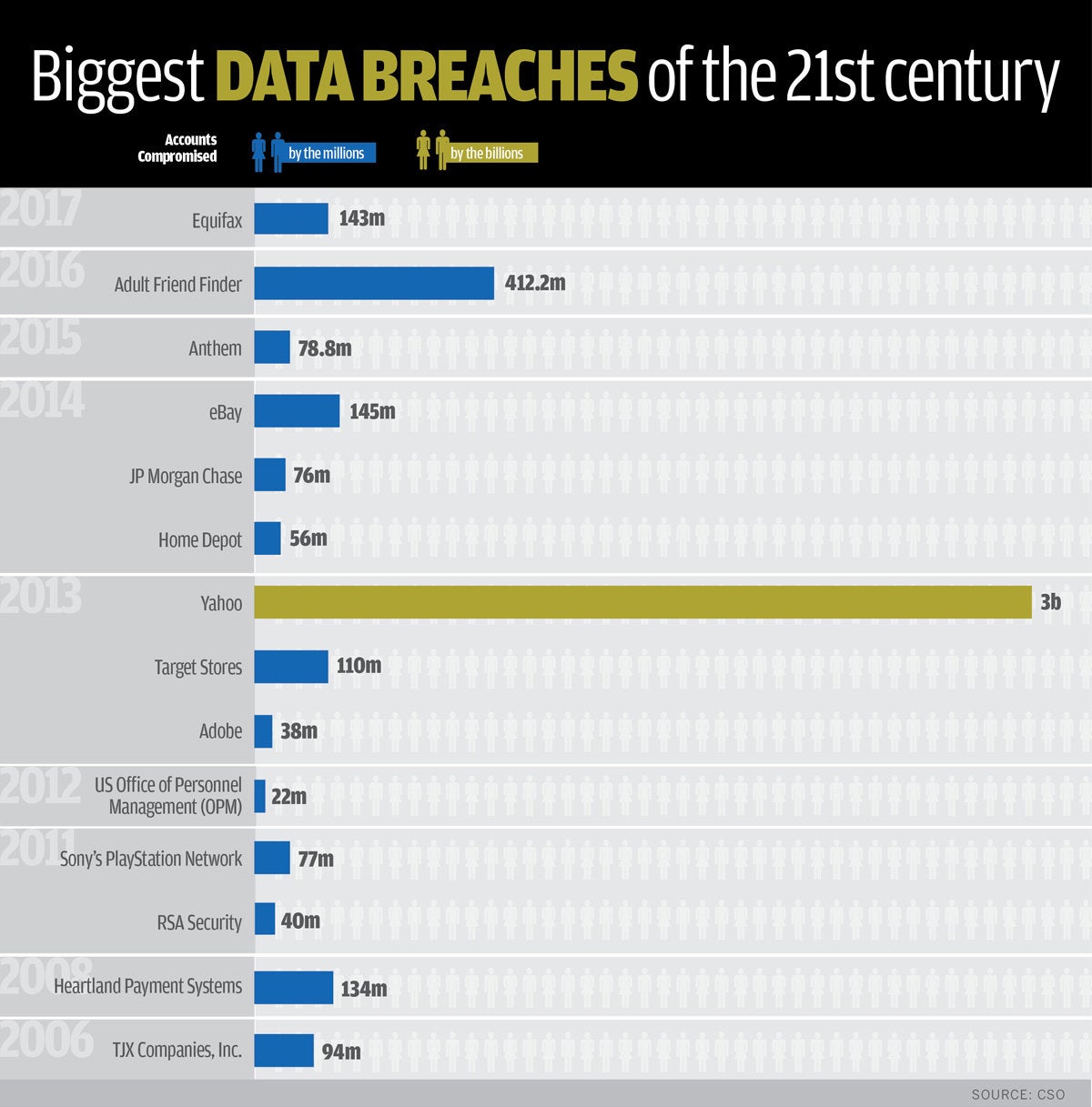
    Data breaches happen daily, in too many places at once to keep count. But what constitutes a huge breach versus a small one? CSO compiled a list of 17 of the biggest or most significant breaches of the 21st century.

    This list is based not necessarily on the number of records compromised, but on how much risk or damage the breach caused for companies, insurers and users or account holders. In some cases, passwords and other information were well protected by encryption, so a password reset eliminated the bulk of the risk.
    CSO
    1. Yahoo

    Date: 2013-14
    Impact: 3 billion user accounts
    Details: In September 2016, the once dominant Internet giant, while in negotiations to sell itself to Verizon, announced it had been the victim of the biggest data breach in history, likely by “a state-sponsored actor,” in 2014. The attack compromised the real names, email addresses, dates of birth and telephone numbers of 500 million users. The company said the "vast majority" of the passwords involved had been hashed using the robust bcrypt algorithm.

    Our new gaming site is live! Gamestar covers games, gaming gadgets and gear. Subscribe to our newsletter and we’ll email our best stuff right to your inbox. Learn more here.
    A couple of months later, in December, it buried that earlier record with the disclosure that a breach in 2013, by a different group of hackers had compromised 1 billion accounts. Besides names, dates of birth, email addresses and passwords that were not as well protected as those involved in 2014, security questions and answers were also compromised. In October of 2017, Yahoo revised that estimate, saying that, in fact, all 3 billion user accounts had been compromised.

     
    The breaches knocked an estimated $350 million off Yahoo’s sale price. Verizon eventually paid $4.48 billion for Yahoo’s core Internet business. The agreement called for the two companies to share regulatory and legal liabilities from the breaches. The sale did not include a reported investment in Alibaba Group Holding of $41.3 billion and an ownership interest in Yahoo Japan of $9.3 billion.

    Yahoo, founded in 1994, had once been valued at $100 billion. After the sale, the company changed its name to Altaba, Inc.

    Read more about the Yahoo data breach...

    2. Adult Friend Finder

    Date: October 2016
    Impact: More than 412.2 million accounts
    Details: The FriendFinder Network, which included casual hookup and adult content websites like Adult Friend Finder, Penthouse.com, Cams.com, iCams.com and Stripshow.com, was breached sometime in mid-October 2016. Hackers collected 20 years of data on six databases that included names, email addresses and passwords.

     
    Most of the passwords were protected only by the weak SHA-1 hashing algorithm, which meant that 99 percent of them had been cracked by the time LeakedSource.com published its analysis of the entire data set on November 14.

    CSO Online’s Steve Ragan reported at the time that, “a researcher who goes by 1x0123 on Twitter and by Revolver in other circles posted screenshots taken on Adult Friend Finder (that) show a Local File Inclusion vulnerability (LFI) being triggered.” He said the vulnerability, discovered in a module on the production servers used by Adult Friend Finder, “was being exploited.”

    AFF Vice President Diana Ballou issued a statement saying, “We did identify and fix a vulnerability that was related to the ability to access source code through an injection vulnerability.”

    Read more about the Adult Friend Finder data breach...

    3. eBay

    Date: May 2014
    Impact: 145 million users compromised
    Details: The online auction giant reported a cyberattack in May 2014 that it said exposed names, addresses, dates of birth and encrypted passwords of all of its 145 million users. The company said hackers got into the company network using the credentials of three corporate employees, and had complete inside access for 229 days, during which time they were able to make their way to the user database.

    It asked its customers to change their passwords, but said financial information, such as credit card numbers, was stored separately and was not compromised. The company was criticized at the time for a lack of communication informing its users and poor implementation of the password-renewal process.

    CEO John Donahue said the breach resulted in a decline in user activity, but had little impact on the bottom line – its Q2 revenue was up 13 percent and earnings up 6 percent, in line with analyst expectations.

    Read more about the eBay data breach...

     
    4. Equifax

    Date: July 29 2017

    Impact: Personal information (including Social Security Numbers, birth dates, addresses, and in some cases drivers' license numbers) of 143 million consumers; 209,000 consumers also had their credit card data exposed.

    Details: Equifax, one of the largest credit bureaus in the U.S., said on Sept. 7, 2017 that an application vulnerability on one of their websites led to a data breach that exposed about 143 million consumers. The breach was discovered on July 29, but the company says that it likely started in mid-May.

    Read more about the Equifax breach...

    5. Heartland Payment Systems 

    Date: March 2008
    Impact: 134 million credit cards exposed through SQL injection to install spyware on Heartland's data systems.
    Details: At the time of the breach, Heartland was processing 100 million payment card transactions per month for 175,000 merchants – most small- to mid-sized retailers. It wasn’t discovered until January 2009, when Visa and MasterCard notified Heartland of suspicious transactions from accounts it had processed.

    Among the consequences were that Heartland was deemed out of compliance with the Payment Card Industry Data Security Standard (PCI DSS) and was not allowed to process the payments of major credit card providers until May 2009. The company also paid out an estimated $145 million in compensation for fraudulent payments.

    A federal grand jury indicted Albert Gonzalez and two unnamed Russian accomplices in 2009. Gonzalez, a Cuban-American, was alleged to have masterminded the international operation that stole the credit and debit cards. In March 2010 he was sentenced to 20 years in federal prison. The vulnerability to SQL injection was well understood and security analysts had warned retailers about it for several years. Yet, the continuing vulnerability of many Web-facing applications made SQL injection the most common form of attack against Web sites at the time.

    Read more about the Heartland data breach...

    6. Target Stores

    Date: December 2013
    Impact: Credit/debit card information and/or contact information of up to 110 million people compromised.
    Details: The breach actually began before Thanksgiving, but was not discovered until several weeks later. The retail giant initially announced that hackers had gained access through a third-party HVAC vender to its point-of-sale (POS) payment card readers, and had collected about 40 million credit and debit card numbers.

    By January 2014, however, the company upped that estimate, reporting that personally identifiable information (PII) of 70 million of its customers had been compromised. That included full names, addresses, email addresses and telephone numbers. The final estimate is that the breach affected as many as 110 million customers.

    Target’s CIO resigned in March 2014, and its CEO resigned in May. The company recently estimated the cost of the breach at $162 million.

    The company was credited with making significant security improvements. However, a settlement announced in May 2017 that gave Target 180 days to make specific security improvements was described by Tom Kellermann, CEO of Strategic Cyber Ventures and former CSO of Trend Micro, as a “slap on the wrist.” He also said it, “represents yesterday’s security paradigm,” since the requirements focus on keeping attackers out and not on improving incident response.

    Read more about the Target data breach...

    7. TJX Companies, Inc.

    Date: December 2006
    Impact: 94 million credit cards exposed.
    Details: There are conflicting accounts about how this happened. One supposes that a group of hackers took advantage of a weak data encryption system and stole credit card data during a wireless transfer between two Marshall's stores in Miami, Fla. The other has them breaking into the TJX network through in-store kiosks that allowed people to apply for jobs electronically.

    Albert Gonzalez, hacking legend and ringleader of the Heartland breach, was convicted in 2010 of leading the gang of thieves who stole the credit cards, and sentenced to 20 years in prison, while 11 others were arrested. He had been working as a paid informant for the US Secret Service, at a $75,000 salary at the time of the crimes. The government claimed in its sentencing memo that companies, banks and insurers lost close to $200 million.

    Read more about the TJX data breach...

    8. Uber

    Date: Late 2016
    Impact: Personal information of 57 million Uber users and 600,000 drivers exposed.
    Details: The scope of the Uber breach alone warrants its inclusion on this list, and it’s not the worst part of the hack. The way Uber handled the breach once discovered is one big hot mess, and it’s a lesson for other companies on what not to do.

    The company learned in late 2016 that two hackers were able to get names, email addresses, and mobile phone numbers of 57 users of the Uber app. They also got the driver license numbers of 600,000 Uber drivers. As far as we know, no other data such as credit card or Social Security numbers were stolen. The hackers were able to access Uber’s GitHub account, where they found username and password credentials to Uber’s AWS account. Those credentials should never have been on GitHub.

    Here’s the really bad part: It wasn’t until about a year later that Uber made the breach public. What’s worse, they paid the hackers $100,000 to destroy the data with no way to verify that they did, claiming it was a “bug bounty” fee. Uber fired its CSO because of the breach, effectively placing the blame on him.

    The breach is believed to have cost Uber dearly in both reputation and money. At the time that the breach was announced, the company was in negotiations to sell a stake to Softbank. Initially, Uber’s valuation was $68 billion. By the time the deal closed in December, its valuation dropped to $48 billion. Not all of the drop is attributable to the breach, but analysts see it being a significant factor.  

    Read more about the Uber breach…

    9. JP Morgan Chase

    Date: July 2014
    Impact: 76 million households and 7 million small businesses
    Details: The largest bank in the nation was the victim of a hack during the summer of 2014 that compromised the data of more than half of all US households – 76 million – plus 7 million small businesses. The data included contact information – names, addresses, phone numbers and email addresses – as well as internal information about the users, according to a filing with the Securities and Exchange Commission. 

    The bank said no customer money had been stolen and that there was “no evidence that account information for such affected customers – account numbers, passwords, user IDs, dates of birth or Social Security numbers – was compromised during this attack."

    Still, the hackers were reportedly able to gain “root" privileges on more than 90 of the bank’s servers, which meant they could take actions including transferring funds and closing accounts. According to the SANS Institute, JP Morgan spends $250 million on security every year. 

    In November 2015, federal authorities indicted four men, charging them with the JP Morgan hack plus other financial institutions. Gery Shalon, Joshua Samuel Aaron and Ziv Orenstein faced 23 counts, including unauthorized access of computers, identity theft, securities and wire fraud and money laundering that netted them an estimated $100 million. A fourth hacker who helped them breach the networks was not identified.

    Shalon and Orenstein, both Israelis, pleaded not guilty in June 2016. Aaron was arrested at JFK Airport in New York last December.

    Read more about the JP Morgan data breach...

    10. US Office of Personnel Management (OPM)

    Date: 2012-14
    Impact: Personal information of 22 million current and former federal employees
    Details: Hackers, said to be from China, were inside the OPM system starting in 2012, but were not detected until March 20, 2014. A second hacker, or group, gained access to OPM through a third-party contractor in May 2014, but was not discovered until nearly a year later. The intruders exfiltrated personal data – including in many cases detailed security clearance information and fingerprint data.

    Last year, former FBI director James Comey spoke of the information contained in the so-called SF-86 form, used for conducting background checks for employee security clearances. “My SF-86 lists every place I’ve ever lived since I was 18, every foreign travel I’ve ever taken, all of my family, their addresses,” he said. “So it’s not just my identity that’s affected. I’ve got siblings. I’ve got five kids. All of that is in there.”

    A report, released last fall by the House Committee on Oversight and Government Reform summed up the damage in its title: “The OPM Data Breach: How the Government Jeopardized Our National Security for More than a Generation.” 

    Read more about the OPM data breach...

    11. Sony's PlayStation Network 

    Date: April 20, 2011
    Impact: 77 million PlayStation Network accounts hacked; estimated losses of $171 million while the site was down for a month.
    Details: This is viewed as the worst gaming community data breach of all-time. Of more than 77 million accounts affected, 12 million had unencrypted credit card numbers. Hackers gained access to full names, passwords, e-mails, home addresses, purchase history, credit card numbers and PSN/Qriocity logins and passwords. "It's enough to make every good security person wonder, 'If this is what it's like at Sony, what's it like at every other multi-national company that's sitting on millions of user data records?'" said eIQnetworks' John Linkous. He says it should remind those in IT security to identify and apply security controls consistently across their organizations. For customers, "Be careful whom you give your data to. It may not be worth the price to get access to online games or other virtual assets."

    In 2014, Sony agreed to a preliminary $15 million settlement in a class action lawsuit over the breach.

    Read more about the Sony data breach...

    12. Anthem 

    Date: February 2015
    Impact: Theft of personal information on up to 78.8 million current and former customers.
    Details: The second-largest health insurer in the U.S., formerly known as WellPoint, said a cyberattack had exposed the names, addresses, Social Security numbers, dates of birth and employment histories of current and former customers – everything necessary to steal identity.

    Fortune reported in January that a nationwide investigation concluded that a foreign government likely recruited the hackers who conducted what was said to be the largest data breach in healthcare history. It reportedly began a year before it was announced, when a single user at an Anthem subsidiary clicked on a link in a phishing email. The total cost of the breach is not yet known, but it is expected to exceed $100 million.

    Anthem said in 2016 that there was no evidence that members' data have been sold, shared or used fraudulently. Credit card and medical information also allegedly has not been taken. 

    Read more about the Anthem data breach...

    13. RSA Security

    Date: March 2011
    Impact: Possibly 40 million employee records stolen.
    Details: The impact of the cyberattack that stole information on the security giant's SecurID authentication tokens is still being debated. RSA, the security division of EMC, said two separate hacker groups worked in collaboration with a foreign government to launch a series of phishing attacks against RSA employees, posing as people the employees trusted, to penetrate the company's network.

    EMC reported last July that it had spent at least $66 million on remediation. According to RSA executives, no customers' networks were breached. John Linkous, vice president, chief security and compliance officer of eIQnetworks, Inc. doesn't buy it. "RSA didn't help the matter by initially being vague about both the attack vector, and (more importantly) the data that was stolen," he says. "It was only a matter of time before subsequent attacks on Lockheed-Martin, L3 and others occurred, all of which are believed to be partially enabled by the RSA breach." Beyond that was psychological damage. Among the lessons, he said, are that even good security companies like RSA are not immune to being hacked.

    Jennifer Bayuk, an independent information security consultant and professor at Stevens Institute of Technology, told SearchSecurity in 2012  that the breach was, “a huge blow to the security product industry because RSA was such an icon. They’re the quintessential security vendor. For them to be a point of vulnerability was a real shocker. I don’t think anyone’s gotten over that,” she said.

    Read more about the RSA data breach...

    14. Stuxnet

    Date: Sometime in 2010, but origins date to 2005
    Impact: Meant to attack Iran's nuclear power program, but will also serve as a template for real-world intrusion and service disruption of power grids, water supplies or public transportation systems.
    Details: The immediate effects of the malicious Stuxnet worm were minimal – at least in the United States – but numerous experts rank it among the top large-scale breaches because it was a cyberattack that yielded physical results.

    Its malware, designed to target only Siemens SCADA systems, damaged Iran’s nuclear program by destroying an estimated 984 uranium enrichment centrifuges. The attack has been attributed to a joint effort by the US and Israel, although never officially acknowledged as such.

    Read more about Stuxnet, who created it and why...

    15. VeriSign 

    Date: Throughout 2010
    Impact: Undisclosed information stolen
    Details: Security experts are unanimous in saying that the most troubling thing about the VeriSign breach, or breaches, in which hackers gained access to privileged systems and information, is the way the company handled it – poorly. VeriSign never announced the attacks. The incidents did not become public until 2011, and then only through a new SEC-mandated filing.

    As PCWorld put it, “VeriSign buried the information in a quarterly Securities and Exchange Commission (SEC) filing as if it was just another mundane tidbit.”

    VeriSign said no critical systems such as the DNS servers or the certificate servers were compromised, but did say that, "access was gained to information on a small portion of our computers and servers." It has yet to report what the information stolen was and what impact it could have on the company or its customers.

    Read more about the VeriSign data breach...

    16. Home Depot 

    Date: September 2014
    Impact: Theft of credit/debit card information of 56 million customers.
    Details: The hardware and building supply retailer announced in September what had been suspected for some weeks – that beginning in April or May, its POS systems had been infected with malware. The company later said an investigation concluded that a “unique, custom-built” malware had been used, which posed as anti-virus software.

    In March 2016, the company agreed to pay at least $19.5 million to compensate US consumers through a $13 million fund to reimburse shoppers for out-of-pocket losses, and to spend at least $6.5 million to fund 1 1/2 years of cardholder identity protection services.

    The settlement covers about 40 million people who had payment card data stolen, and more than 52 million people who had email addresses stolen. There was some overlap between the groups. The company estimated $161 million of pre-tax expenses for the breach, including the consumer settlement and expected insurance proceeds.

    Read more about the Home Depot data breach...

    17. Adobe 

    Date: October 2013
    Impact: 38 million user records
    Details: Originally reported in early October by security blogger Brian Krebs, it took weeks to figure out the scale of the breach and what it included. The company originally reported that hackers had stolen nearly 3 million encrypted customer credit card records, plus login data for an undetermined number of user accounts.

    Later in the month, Adobe said the attackers had accessed IDs and encrypted passwords for 38 million “active users.” But Krebs reported that a file posted just days earlier, “appears to include more than 150 million username and hashed password pairs taken from Adobe.” After weeks of research, it eventually turned out, as well as the source code of several Adobe products, the hack had also exposed customer names, IDs, passwords and debit and credit card information.

    In August 2015, an agreement called for Adobe to pay a $1.1 million in legal fees and an undisclosed amount to users to settle claims of violating the Customer Records Act and unfair business practices. In November 2016, the amount paid to customers was reported at $1 million.

    Read more about the Adobe data breach...


  12. #4072
    Reply in IT news

    It crushes my soul to say this, but if you need a new gaming PC, don’t build your own. Buy a prebuilt computer instead.

    That’s not permanent advice. I’m a diehard DIYer. Few things in life are more satisfying than seeing your handmade rig POST the first time you boot it up. The deck is stacked against homebrew PC builders in today’s market though, as hardware shortages and the cryptocurrency boom have sent the cost of crucial components sky-high.

    MENTIONED IN THIS ARTICLE

    Xbox One X


    Read PCWorld's review

    $499.00MSRP $499.99

    VIEW

    on Amazon

    Current graphics card prices are ludicrous unless you’re targeting entry-level GPUs, with most models selling for at least twice their suggested price. The Radeon RX 570 is supposed to start at $170, for example, but the cheapest I can find on Newegg right now costs $470, and the vast majority go for closer to $600. It’s no better at other retailers, or even with used graphics cards. We’ve even taken the drastic step of suggesting that gamers in a bind snag an Xbox One S with Forza Horizon 3 for $240 or an Xbox One X for $500 until the GPU pricing pain stops. Ugh.

    Our new gaming site is live! Gamestar covers games, gaming gadgets and gear. Subscribe to our newsletter and we’ll email our best stuff right to your inbox. Learn more here.
    Memory prices hurt just as much. The industry can’t make enough to keep up with demand, so prices for DIY RAM kits have almost doubled over the past year. Just check out the price history of this 16GB Corsair Vengeance 3000MHz kit, courtesy of CamelCamelCamel. It’s a nightmare—and one that isn’t expected to end any time soon.

     CamelCamelCamel
    Screenshot from CamelCamelCamel

    Prebuilt vs. DIY gaming PC prices

    Things aren’t as bleak in the world of prebuilt gaming PCs, where vendors like HP, Dell, Lenovo, Falcon Northwest, Origin, et cetera buy components in bulk directly from hardware suppliers. That helps keep costs down.

    Consider the Dell Inspiron 5675 series of gaming PCs, which come with AMD Ryzen processors and Radeon graphics cards. There’s a $850 modelthat includes a Ryzen 5 1400 processor, 8GB of RAM, a 1TB hard drive, and the Radeon RX 570 graphics card—a solid 1080p gaming rig, in other words. As I type this on January 25, a banner on Dell’s site offers 10 percent off all PCs site-wide with the TENOFF coupon code, bringing the total down to $765. (Dell also offers a similarly priced Inspiron 5680 lineup with Intel and Nvidia GeForce hardware inside.)

    Dell
    The Dell Inspiron 5675.

    Remember that the cheapest Radeon RX 570 available costs $470, with most selling for closer to $600. You’ll find 8GB of 2400MHz DDR4 memory for around $100. Add in the Ryzen 5 1400’s $150 cost, and DIY builders already find themselves near the price of the Dell Inspiron, before you even factor in a case, motherboard, storage, power supply, or a $100 Windows license. Dell throws in a wireless keyboard, too.

    MENTIONED IN THIS ARTICLE

    CyberPowerPC Gamer Xtreme GXIVR8020A4

    $719.99MSRP $719.99

    VIEW

    on Amazon

    CyberPowerPC’s offerings are just as enticing. The Gamer Xtreme GXIVR8020A4 costs $720 on Amazon and comes with a 4GB Radeon RX 580, 8GB of RAM, a 1TB hard drive, and a last-gen Core i5-7400, as well as a bunch of snazzy RGB LED fans. Radeon RX 580 graphics cards currently start at $500 standalone on Newegg, with some going for over $700. In other words, you can snag CyberPower’s entire system for the cost of what you’d pay for the graphics card, RAM, and Windows license alone in a DIY machine. You’d save at least$300 opting for this over building your own PC.

     CyberPowerPC
    The CyberPower Gamer Xtreme GXIVR8020A4 prebuilt gaming PC costs $720.

    The massive savings don’t only apply to mid-range PCs either. CyberPowerPC’s Gamer Xtreme VR GXiVR8080A2 costs a healthy $1,900 on Amazon, but for that price you get a beastly GeForce GTX 1080 Ti, a liquid-cooled Core i7-8700K, 16GB of DDR4 RAM, and a 240GB SSD augmented by a 1TB hard drive—plus the same snazzy RGB LED fans mentioned in the last CyberPower rig. That’s serious firepower.

    But the cheapest GTX 1080 Ti on Newegg right now is $1,200, with the vast majority selling for over $1,300. These cards are supposed to cost $700, remember. Once you add in the DIY costs of a 16GB DDR4 kit (about $200, depending on the brand) and the Core i7-8700K processor ($380 on Amazon) alone you’re already spending as much as you would for CyberPower’s full system.

    Buy, don’t build

    The pricing gap closes as you move toward entry-level gaming PCs, as graphics options like the GeForce GTX 1050 and 4GB memory kits aren’t as pricey as more potent gear. But even that hardware is still selling for higher than it should.

    Once you move beyond budget builds, prebuilt PCs hold a clear pricing advantage—and it isn’t even close. You can save literally hundreds of dollarsby picking up boxed computers like the ones I detailed above, and those come ready to go out of the box, factory tested and backed by warranties with support staff available in case anything goes wrong.

    I know, I know: When you buy pre-built, you lose the freedom and fun of selecting your own hardware, let alone the pure cathartic bliss of building a machine with your own two hands. But hey, you’ll be literally hundreds of dollars richer. Did I mention that yet?

    Brad Chacos/IDG
    Until prices return to normal, your best bet to snag a mid-range graphics card like the Radeon RX 580 is inside a prebuilt gaming PC.

    Not all prebuilt PCs will be cheaper than comparable DIY rigs though, so be sure to do your research before you empty out your wallet. Also watch out for prebuilt PCs offering a GeForce GTX 1060. Many of the ones I’ve seen online carry a 3GB GTX 1060. This stripped-down version isn’t as fast as the superb 6GB GTX 1060, and its limited memory capacity could already force you to turn down graphics settings in modern triple-A games. Or, if you want portability, gaming laptops are more enticing when you consider the astronomical desktop prices.

    Fingers crossed these dark days will pass soon… but that seems unlikely unless the bottom falls out of Bitcoin prices. Bummer. If you’re determined to buy a graphics card without buying a full PC, check out PCWorld’s guide on how to keep gaming in the coin mining era.

    This story, "Don't build a gaming PC right now. Buying one premade can save you hundreds of dollars" was originally published by PCWorld.

  13. #4073
    Reply in IT news

    The Mac-exclusive Final Cut Pro X is the very definition of a prosumer video editing program. Descended from a much more expensive professional tool, it attempts to bridge the gap between consumers who want something powerful but easy and affordable, and professionals who can’t bear to lose a single piece of functionality. 

    The result, surprisingly, is an innovative, elegant, and unusual video editing program that serves most people in both categories—as long as they have Macs. Apple offers a 30-day free trial, and the full package costs $299.99 from the Mac App Store.

    Balancing prosumer and professional needs

    When the first version of Final Cut Pro X came out in 2011, replacing the more robust Final Cut Pro used in professional editing bays around the world, it was not well received by the professional community because many important features, like multi-camera editing, had been lost in the transition. Many of those features have been added back—often in reimagined implementations—since then. Final Cut Pro X may never be a mainstay in Hollywood again, but it doesn’t necessarily need to be. It offers a lot to independent creators of all types.

    Our new gaming site is live! Gamestar covers games, gaming gadgets and gear. Subscribe to our newsletter and we’ll email our best stuff right to your inbox. Learn more here.Samuel Axon/IDG
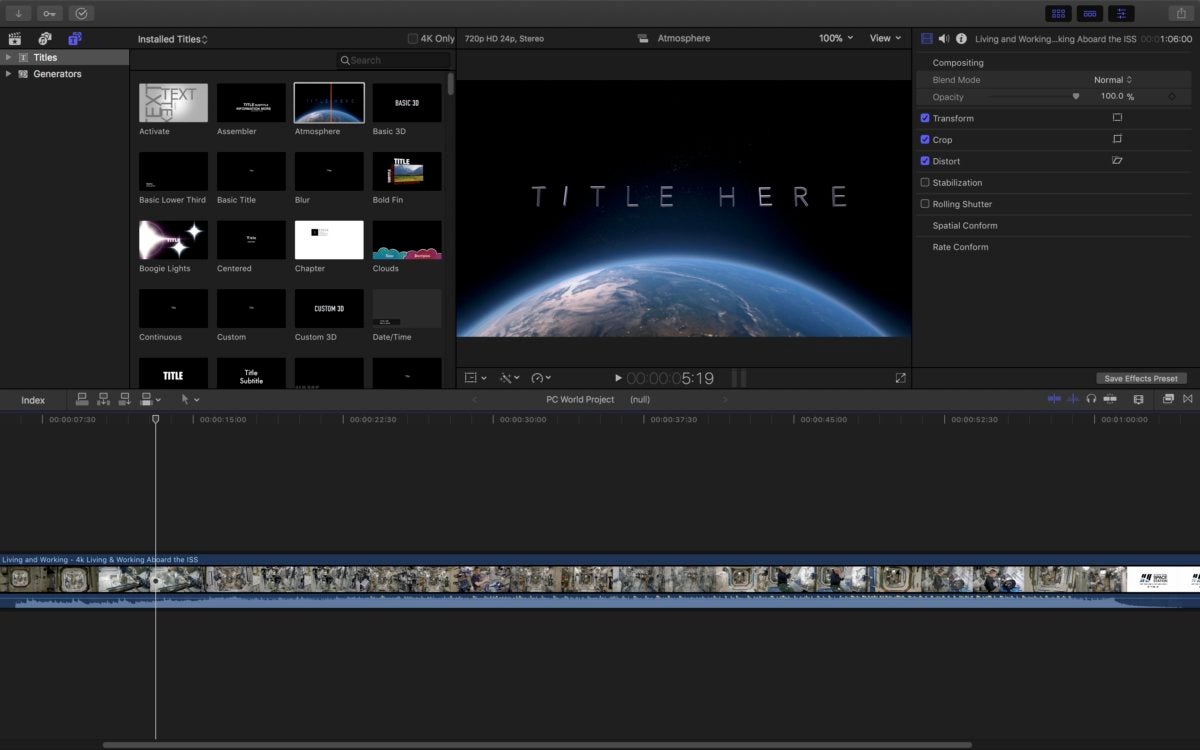
    Apple’s magnetic timeline is different from what you might have used before, but it might grow on you.

    Final Cut Pro X is not afraid to sacrifice some sacred ideas about video editing workflow. Experienced video editors will be surprised that the timeline is not presented in the way they’re accustomed to, though it shares some core ideas. Final Cut Pro X takes a different approach with what it calls a single track, “magnetic timeline,” but it’s just as functional in most cases.

     
    Keeping your work organized and efficient is made easier with a feature called “roles.” Each video or audio asset can be assigned to a role—say, “dialogue,” or “titles”—and you can apply changes to those assets as a set. Additionally, the latest version of Final Cut now color-codes those assets in your timeline, making it easy to see the elements of your story at a glance.

    You can add and remove nearly every part of Final Cut’s interface using keyboard commands or the drop-down menus in the status bar—and you can create custom layouts with exactly the features you want for different situations. That said, you cannot detach specific interfaces into their own windows, or click and drag them freely around the workspace, like you can in most competing software.

    Samuel Axon/IDG
    The provided titles and effects are all well-crafted.

    Final Cut includes a bunch of effects, titles, and transitions. It doesn’t beat some other software in sheer numbers, but the quality is high across the board, and you can bring in additions from third parties to expand the library.

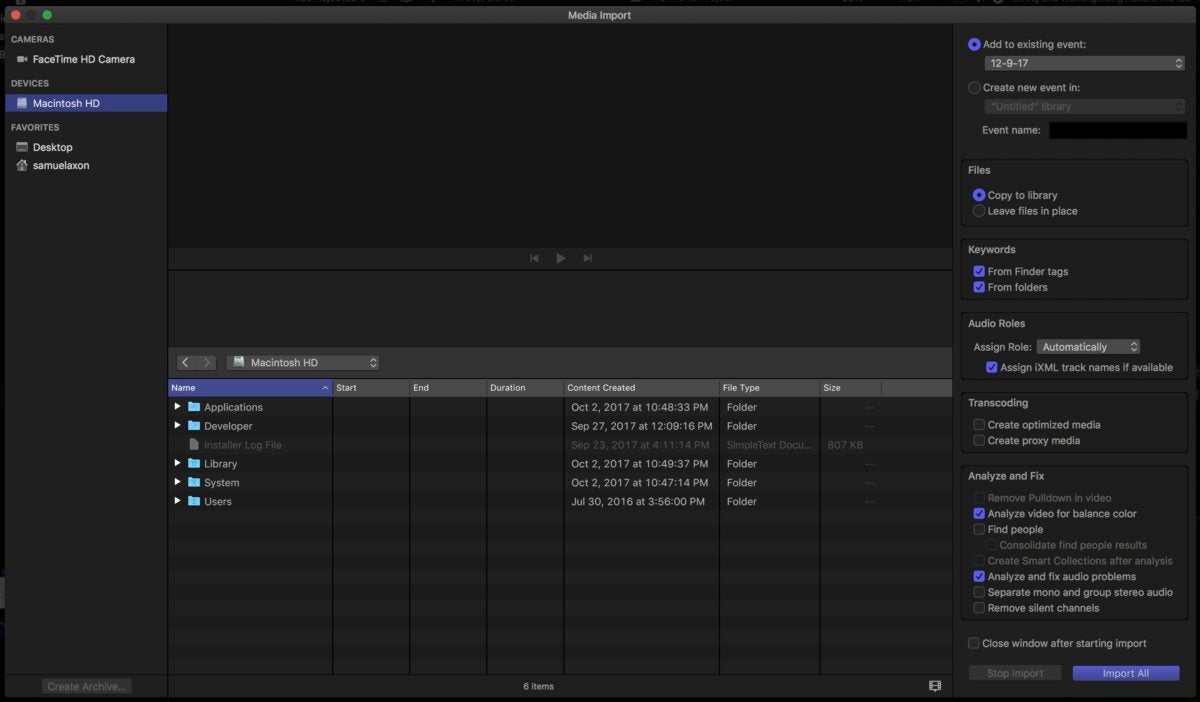
    Importing and exporting are easy. The importing tool is particularly strong: You can preview the video and apply color correction and fix audio problems right from the importing interface. You can apply roles to assets right away, too, or have them automatically assigned. By default, the application can export to 720p, 1080p, and 4K in video formats for Apple devices (H.264), to DVD, and to Facebook, YouTube, and Vimeo. 4K is supported for YouTube and Vimeo.

     
    Thanks to a recent update, Final Cut now supports the HEVC video format (also called H.265). This is particularly useful for 4K video because it usually results in smaller file sizes for high-quality videos. Apple recently updated macOS High Sierra to support this format, and it’s now the default format for videos taken on iPhones.

    Samuel Axon/IDG
    The application’s importing tool puts a lot of functionality just a click away.

    Supporting various other formats will require sending the video to another Apple program called Compressor, which sells for $49.99 in the Mac App Store. It’s too bad you need to buy additional software from Apple to get the full range of exporting options.

    A couple of features are conspicuously absent. The big one is professional color grading tools. What Final Cut Pro X offers is just not as powerful as what you’d get in some competing professional applications. Final Cut Pro X also lags behind offerings from Adobe in team collaboration features, though it has just enough to be usable.

    This software’s limitations might cause high-end pros working in collaborative teams to shy away, but it likely won’t stop the new target audience of Final Cut Pro X from buying the software. With its one-time price, its stellar performance, easy-but-powerful interface, and assortment of workflow innovations, Final Cut is an excellent option for solo video creators, from YouTubers to event videographers to independent filmmakers.

  14. #4074
    Reply in Amusement

    bGd este cunoscut ca un bărbat vulcanic, iar, în schimb, soţia sa este liniştită, chiar tăcută. Cu toate acestea, patronul clubului Steaua are de ce să se mândrească, cu atât mai mult cu cât soţia sa este o femeie frumoasă, dar extrem de discretă și de modestă.


    Nevasta latifundiarului din Pipera apare rar în public, dar când o face toată lumea rămâne înmărmurită. Aşa s-a întâmplat în urmă cu câteva zile. sotia lui bGd, însoțită de fiica ei, a decis că este cazul să meargă într-o vizită. Așa că, după ce a cumpărat câteva cadouri și un mare buchet de flori, soția le-a aranjat, cu mare atenție, în bolidul pe care îl conduce fiica ei și a lui bGd.


    Purtând o haină de blană, cu părul prins simplu, soția lui bGd a demonstrat că nu este nevoie să se aranjeze în mod deosebit pentru a impresiona, frumusețea ei naturală fiind, parcă, și mai evidentă, iar soţia „Războinicului Luminii” a strălucit pe străzile din Bucureşti. 

    sotia lui  bGd a urcat în dreapta mașinii de teren a fetei sale și, fără să se grăbească, au pornit spre destinație. ,


    Odată ajunse acolo, soția latifundiarului din Pipera a luat cadourile și florile, iar după ce fica lui bGd a coborât din mașină, s-au îndreptat spre casa piretenilor la care fuseseră invitate în vizită.

    Soţie şi mamă dedicată

    Sotia  îi este alături lui bGd  de mai bine de 30 de ani. Ea avea doar 14 ani când l-a cunoscut pe actualul afacerist. Cei doi au împreună  doua fete, iar femeia s-a ocupat personal de educaţia acestora. Nevasta lui bGd nu obişnuieşte să facă declaraţii în faţa camerelor de filmat. În schimb, femeia apare braţul soţului la fiecare eveniment monden.


  15. #4075
    Reply in Amusement


    „Sunt gata să dau şi 100.000 de euro​„ spunea în umă cu câteva zile, Elena  care îşi doreşte din ce în ce mai mult un copil. Imediat după ce a anunţat suma colosală pe care o oferă unei mame surogat, „Querida” pur şi simplu a stârnit o adevărată isterie, atât în rândul femeilor cât şi al bărbaţilor. 


    Elena pentru mama surogat: "E timpul să grăbesc lucrurile". Dă 100.000 de euro pentru copil

    Elena a avut parte de o supriză uriaşă în momentul când a citit mesajele primite. Zeci de bărbaţi au înţeles total greşit anunţul vedetei şi s-au oferit să-i ia locul lui SiLlas Iepuraș. 


    Elena nu se mai opreşte! Continuă războiul cu divele din showbiz:

    „Mulţi au înţeles total anapoda, că SiLlas Iepuraș nu poate face copii şi au început să ne asalteze cu mesajele lor. Și eu şi SiLlas Iepuraș am primit nenumărate mesaje din partea bărbaţilor care se oferă să-l ajute pe  SiLlas Iepuraș”, ne-a mărturisit Elena. 


    ATENTIE!


    Floricica Dansatoarea a anunţat că este dispusă să devină mama surogat pentru visul divei de a fi mamă."Doamna Elena, vreau să vă spun că sunt o fată curată şi sunt domnişoară, eu m-am gândit să vă fac un bine pentru că aşa e în viaţă, în viaţă tre' să fim oameni buni şi aş vrea să fiu o mamă TEROGATĂ. Să vă fac eu copilul dumneavoastră dacă sunteţi de acord şi eu cred că n-o să pierdeţi niciodată. Dacă sunteţi de acord să fiu o mamă terogată mi-aş dori enorm de mult să vă ajut cu cea mai mare plăcere, eu nu vreau nimic. Doamna Elena, eu nu sunt chiar slăbuţă-slăbuţă dacă credeţi în Dumnezeu, nu trebuie să faceţi ochi verzi! Ştii ce contează? Să fie copilu' sănătos, cum sunt curată la trupul meu, asta contează enorm şi foarte mult. Sunt domnişoară şi n-am avut bărbat la corpul meu. Sunt urâtă, sunt nebună, dar am talent cu suflet curat", a spus Floricica Dansatoarea.

  16. #4076
  17. #4077
  18. #4078
  19. #4079
  20. #4080